
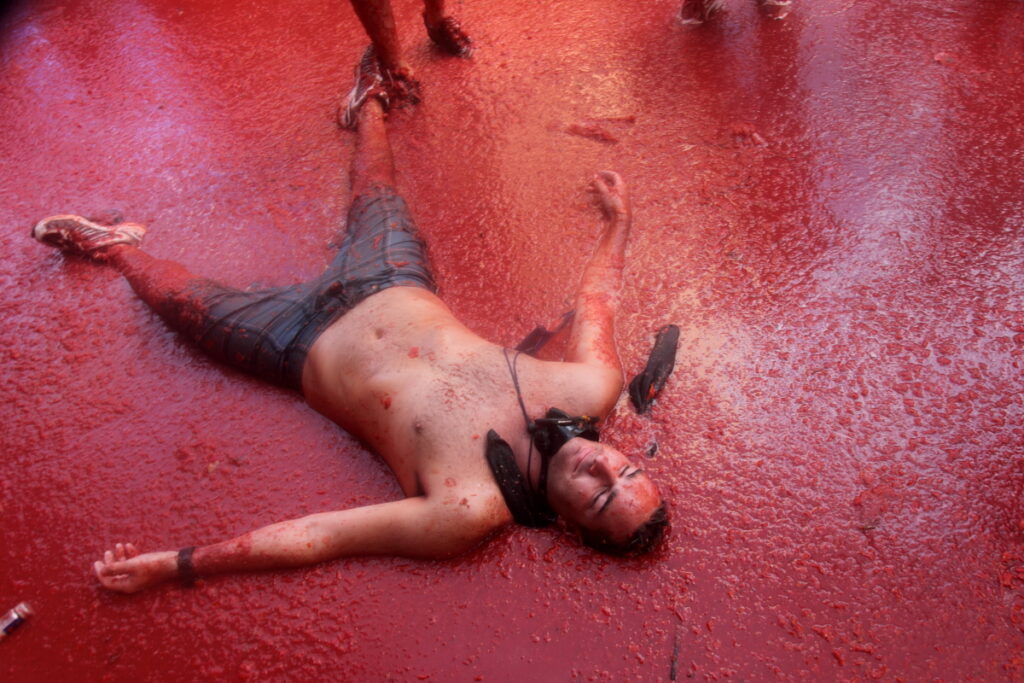
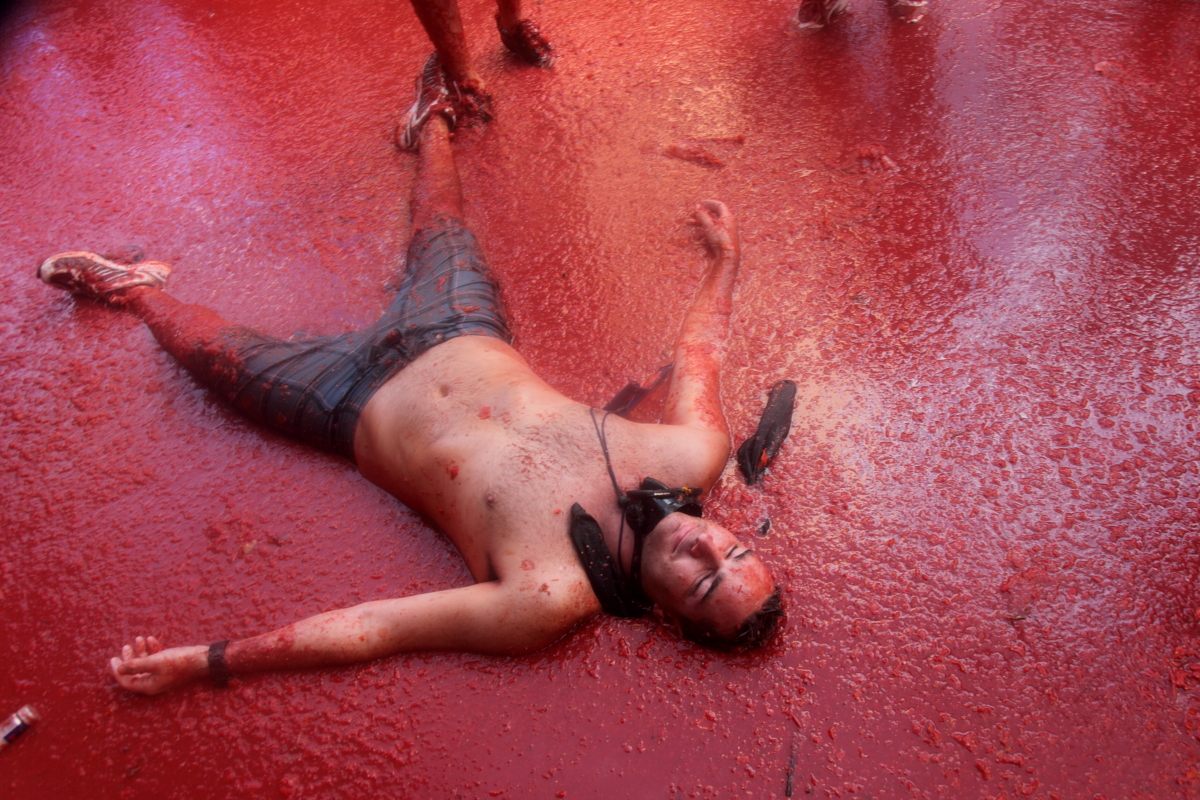
For roughly one hour on the last Wednesday of every August, the streets of Buñol turn ankle-deep in red pulp as tens of thousands of people hurl overripe tomatoes at one another. It is not an ancient rite or a harvest ritual — it began, by most accounts, as an impromptu scuffle in the town square in 1945 and simply refused to die. This is Guide № 002 in The Love Spain Guide series.
Get the Full Collectible Guide (Free PDF)
La Tomatina — in a beautifully designed, printable booklet. The Love Spain Guide № 002.
Where and When It Happens
La Tomatina takes place in Buñol, a small town of around 9,000 people in the province of Valencia, roughly 40 kilometres inland from the city of Valencia itself. The main tomato fight is held on the last Wednesday of August and lasts about an hour, from around 11am until midday, though the surrounding festival runs for the better part of a week with music, parades, and fireworks.
Because Buñol is so small, the event completely overwhelms the town for the day. Trains run from Valencia’s Estació del Nord, and most participants arrive in the morning and leave by the afternoon once the streets have been hosed clean.
How the Fight Actually Works
Trucks loaded with tomatoes drive into the Plaza del Pueblo, and crews tip their cargo into the crowd. The start is traditionally tied to the palo jabón — a greased wooden pole with a ham fixed at the top that people try to climb — though in practice the fight kicks off with the firing of a water cannon or rocket, and ends the same way an hour later. When the second signal sounds, throwing must stop immediately.
There are real rules. Tomatoes must be squashed in your hand before you throw them so they cannot injure anyone, no other projectiles or bottles are allowed, and you must not tear other people’s clothing. Organisers typically truck in well over 100 tonnes of low-grade, overripe tomatoes grown specifically for the event — they are not fit to sell as food, so nothing edible is wasted.
The Origin Story
The most widely repeated account traces the festival to 1945, when a scuffle broke out during a parade in the town square and young people grabbed tomatoes from a nearby vegetable stall to throw at each other. It is said they returned to repeat it the following year, and the tradition grew from there despite early attempts by authorities to shut it down.
The event was reportedly banned at points during the Franco era before being formally permitted again in the late 1950s. Whatever the exact details, La Tomatina is very much a 20th-century invention rather than an old folk custom — which is part of what makes its scale today so striking.
Getting In: Tickets and Crowds
For most of its history La Tomatina was free and open, but crowd sizes grew unmanageable. Since 2013 the event has been ticketed and capped, with attendance limited to around 20,000 people to keep the town safe. Tickets are sold in advance, and many visitors buy them as part of transport-and-entry packages from Valencia.
If you plan to go, wear old clothes and closed shoes you can throw away, use goggles to protect your eyes from the acidic juice, and leave anything valuable behind — phones and cameras rarely survive unless sealed in waterproof cases.
The Clean-Up
One of the more surprising details is how quickly Buñol recovers. Once the fight ends, fire trucks and residents hose down the streets and buildings, and the town is usually clean within a couple of hours. The acidity of the tomato juice actually helps disinfect the cobblestones, which end up notably clean afterwards. Many participants rinse off at makeshift showers or in the nearby Buñol River.
Myths Worth Retiring
Myth: La Tomatina is an ancient Spanish tradition. It dates only to 1945, making it younger than many living memories. It draws on no religious or agricultural rite — it grew from a single spontaneous food fight.
Myth: The tomatoes are wasted food. The tomatoes used are a cheap, overripe variety grown for the purpose and unsuitable for sale, so no market-grade produce is thrown away.
Myth: Anyone can just show up and join in. Since 2013 the fight has required a paid ticket, with a strict cap on numbers. Turning up without one will not get you into the main plaza.
Frequently Asked Questions
How many tomatoes are used?
Organisers bring in well over 100 tonnes of tomatoes each year, delivered by truck into the town square. They are an inexpensive, overripe variety grown specifically for the event.
Is it dangerous?
It is generally safe if you follow the rules, but the crowd is dense and the ground becomes very slippery. Squashing tomatoes before throwing is required to prevent injury, and goggles are strongly recommended because the juice stings the eyes.
Do I need to speak Spanish to take part?
No. La Tomatina draws visitors from all over the world, and the event itself needs no language at all. That said, learning a few basic phrases and reading the safety rules in advance will make your day in Buñol run more smoothly.
More The Love Spain Guides
The Love Spain Guide is a numbered series — one tightly focused subject at a time, each with its own downloadable collectible edition. Guide № 001 is Jamón Ibérico, This is Guide № 002. More editions are on the way.
🇪🇸 Join Love Spain
Every week, get hidden stories, local secrets, and travel inspiration from people who live and love it.
Tours & experiences in Spain


Powered by Viator. Some links are affiliate links — we may earn a small commission at no extra cost to you.