
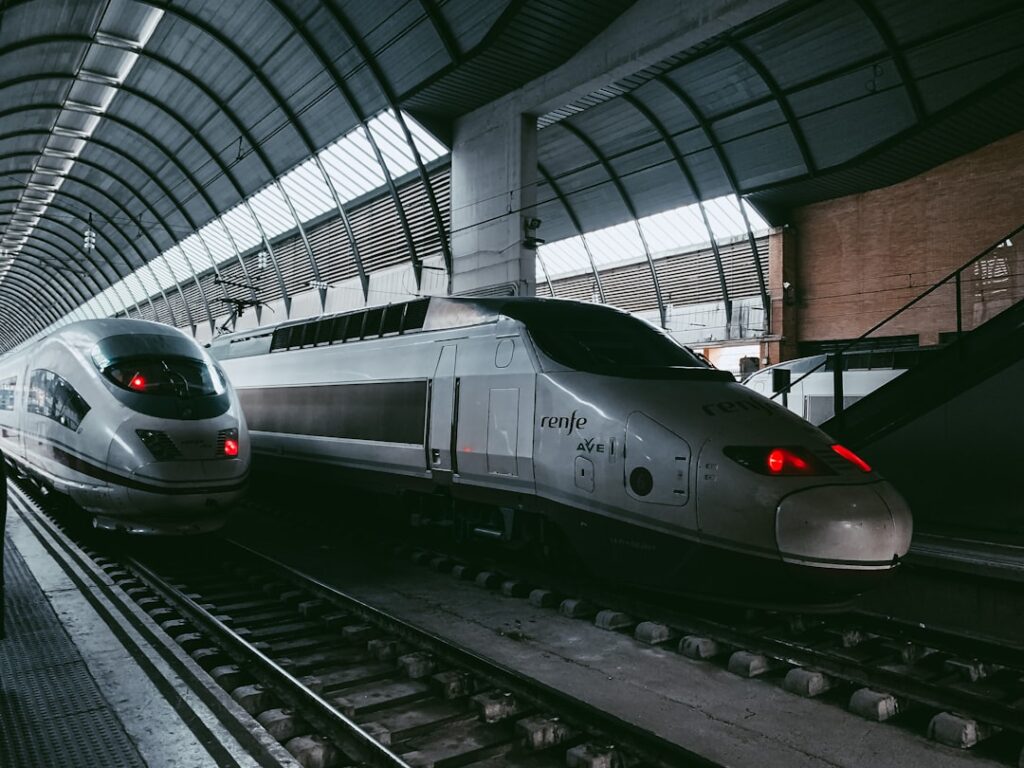
Spain‘s high-speed rail network is one of Europe’s best-kept secrets—and one of its longest. The AVE (Alta Velocidad Española) trains whisk you between major cities at speeds up to 300 kilometers per hour, turning what used to be grueling bus rides into smooth, scenic journeys. Madrid to Seville in two and a half hours. Barcelona to Madrid in under three. Valencia to the capital in an hour and forty minutes.
If you’re planning to see more than one city, the train is almost always your best option. Here’s everything you need to know to ride Spain’s rails like a local.
The Routes That Matter
The backbone of Spain’s AVE network is the Madrid-Barcelona line, opened in 2008 and still the country’s busiest. Trains leave roughly every hour from Madrid’s Puerta de Atocha station and arrive at Barcelona Sants in about two hours and forty-five minutes. You’ll pass through Zaragoza, where you can stop to see the Basílica del Pilar if you’re not in a rush.
The Madrid-Seville route is nearly as convenient—two and a half hours city center to city center, with trains departing every hour or two throughout the day. This line also serves Córdoba, making it easy to visit the Mezquita on your way south.
From Madrid, you can also reach Valencia, Málaga, Alicante, and even Galicia on high-speed services. The network continues to expand, with new routes and faster connections added regularly. Barcelona now connects directly to Seville and Málaga, bypassing Madrid entirely.
Booking Your Tickets
Book directly through Renfe, Spain’s national rail operator, at renfe.com. The site can be finicky—use a browser with automatic translation if your Spanish is shaky, and be patient with the payment page. Tickets go on sale about sixty days in advance, and prices work like airlines: the earlier you book, the less you pay.
Look for “Promo” and “Promo+” fares, which can be half the price of flexible tickets. The catch? They’re non-refundable and non-changeable. “Turista” is standard class; “Turista Plus” gets you a bit more legroom and a snack. “Preferente” is business class with meals and lounge access, but it’s rarely worth the premium unless someone else is paying.
If you’re under 26, look for the youth discount. Seniors over 60 also qualify for reduced fares. The Tarjeta Dorada (Gold Card) costs about €6 and saves 25–40% on most tickets if you’re traveling off-peak.
What to Expect Onboard
AVE trains are comfortable, quiet, and punctual. Seats are assigned, with plenty of overhead storage for luggage. There’s no weight limit and no security theater—just show up, find your platform on the departure board, and board about ten minutes before departure.
Every train has a café car serving coffee, beer, sandwiches, and snacks at reasonable prices. Free Wi-Fi is available, though the connection can be spotty in tunnels. Power outlets are hit-or-miss depending on the train model—bring a battery pack if you need to work.
The ride itself is smooth enough to read, work, or nap without interruption. Windows are large, and the countryside unfolds at a satisfying pace: olive groves in Andalusia, vineyards in Castile, the red earth of Aragón. It’s far more pleasant than staring at the seatback in front of you on a budget flight.
Station Tips and Timing
Madrid’s Atocha station is part transit hub, part tropical garden—there’s a greenhouse filled with palms and turtles in the original 19th-century hall. Arrive fifteen minutes early to find your platform and grab a coffee. The Sants station in Barcelona is less charming but equally efficient, with good connections to the metro.
In Seville, the Santa Justa station sits about twenty minutes from the old town by bus or taxi. Córdoba’s station is a quick walk to the Mezquita. Valencia’s Joaquín Sorolla station is modern and central, with tram connections to the City of Arts and Sciences.
Security is minimal—there’s no check-in, just a platform number and a departure time. Gates typically open ten minutes before the train leaves. If you’re running late, you might still make it, but don’t count on it. Spanish trains leave on time.
Train vs. Flying
For city pairs under four hours apart, the train wins. You arrive and depart from the city center, there’s no two-hour security buffer, and you can bring a proper bag without fees. The environmental math is better, too—AVE trains produce a fraction of the carbon emissions of a short-haul flight.
Flying makes sense for longer hauls—Madrid to the Canary Islands, Barcelona to Galicia—but for the triangle of Madrid, Barcelona, and Seville, or any of the cities in between, the train is faster door-to-door and far more civilized.
Want more practical tips for exploring Spain by train, car, and foot? Subscribe to the Love Spain newsletter—one short story a day, straight to your inbox, with the insights that make your trip better.
Tours & experiences in Spain


Powered by Viator. Some links are affiliate links — we may earn a small commission at no extra cost to you.