
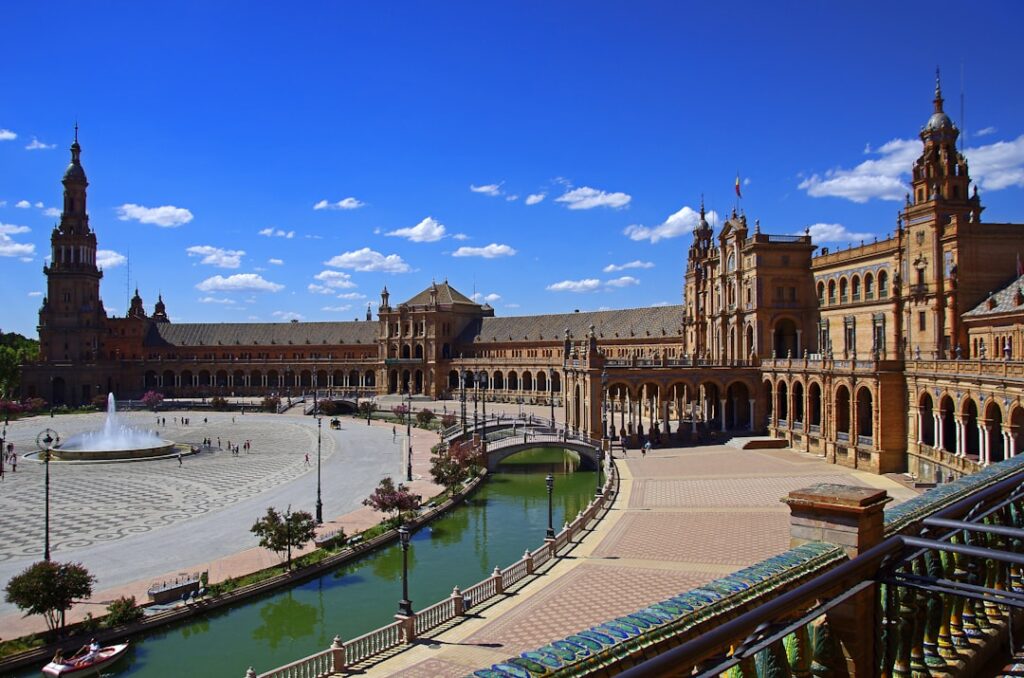
The Plaza de España in Seville is breathtaking even by Spanish standards—a massive semicircular complex of bridges, towers, and hand-painted tiles that wraps around a central fountain and canal. Built in 1928 for the Ibero-American Exposition of 1929, it’s become one of the most photographed landmarks in Spain, and for good reason. The scale alone stops you in your tracks.
Designed by Sevillian architect Aníbal González, the plaza sits at the edge of Parque de María Luisa, a short walk south from the city center. It’s big—50,000 square meters—and combines Renaissance Revival and Moorish Revival styles in a way that feels distinctly Andalusian. The result is both grand and intimate, a public space that manages to be monumental without feeling cold.
What You’ll See
The centerpiece is the semicircular building that wraps around the plaza, punctuated by two 74-meter brick towers at each end. Four bridges cross the canal that runs along the front, each representing one of Spain’s ancient kingdoms. The bridges are gorgeous, detailed with more tilework than seems structurally necessary.
But the real draw is the series of 48 alcoves set into the building’s facade, one for each Spanish province. Each alcove features a tiled bench and mural depicting a historical scene from that province—maps, coats of arms, important moments. It’s worth walking the entire semicircle. The Seville alcove is predictably popular for photos, but don’t miss the smaller provinces. The craftsmanship is extraordinary.
You can rent a rowboat and paddle the canal—it’s touristy, yes, but also genuinely fun, especially if you’re visiting with kids. The boats cost about €6 for 30 minutes and give you a different perspective on the architecture. Early morning or late afternoon is best to avoid the midday heat and crowds.
When to Visit
The plaza is open 24 hours and free to enter, which means you have options. Most tourists arrive between 10 a.m. and 2 p.m., when the light is harsh and the crowds thickest. Come instead at sunrise—around 7 a.m. in summer, 8 a.m. in winter—and you’ll have the place nearly to yourself. The morning light on the east-facing building is soft and golden.
Sunset works too, particularly in spring and fall when the temperatures cool off. The plaza is beautifully lit at night, and it’s a popular spot for evening strolls. Just be prepared for other people to have the same idea, especially on weekends.
Avoid visiting in July and August if you can. Seville is brutally hot in high summer, and the plaza offers almost no shade. If you do come then, go very early or after 8 p.m.
Getting There and Nearby
The Plaza de España is about a 20-minute walk from the Cathedral and the Alcázar, straight down Avenida de la Constitución and through Parque de María Luisa. You can also take tram T1 to Prado de San Sebastián, then walk five minutes through the park.
The park itself deserves at least an hour. It’s Seville’s largest green space, full of orange trees, tiled fountains, and quiet paths. The Museo de Artes y Costumbres Populares and the Museo Arqueológico are both here, housed in pavilions left over from the 1929 exposition. They’re small but worthwhile if you have the time.
For lunch or a drink afterward, head back toward the Santa Cruz neighborhood. Bar Las Teresas on Calle Santa Teresa serves excellent montaditos and cold manzanilla in a classic tiled bar. It’s a five-minute walk from the park’s north entrance.
Film Fans and History Buffs
If the plaza looks familiar, it’s probably because you’ve seen it on screen. It stood in for a plaza in Cairo in Lawrence of Arabia and appeared in both Star Wars: Episode II and The Dictator. Spotting the exact scenes is a minor sport among visitors.
The building now houses government offices for the Andalusian autonomous community, so you can’t go inside most of it. But the alcoves, canal, and central plaza are the real attractions anyway. This is a place built to be walked through slowly, with attention to detail—the ironwork on the railings, the patterns in the tile, the way the light changes as you move along the curve.
Take your time. Bring water. And if you’re looking for the perfect photo, the view from the center of one of the bridges, looking back toward the towers, is hard to beat.
Want more insider tips on Seville and the rest of Spain? Subscribe to the Love Spain newsletter and get one short story a day—real places, honest advice, and the Spain you came to see.
Tours & experiences in Spain


Powered by Viator. Some links are affiliate links — we may earn a small commission at no extra cost to you.