
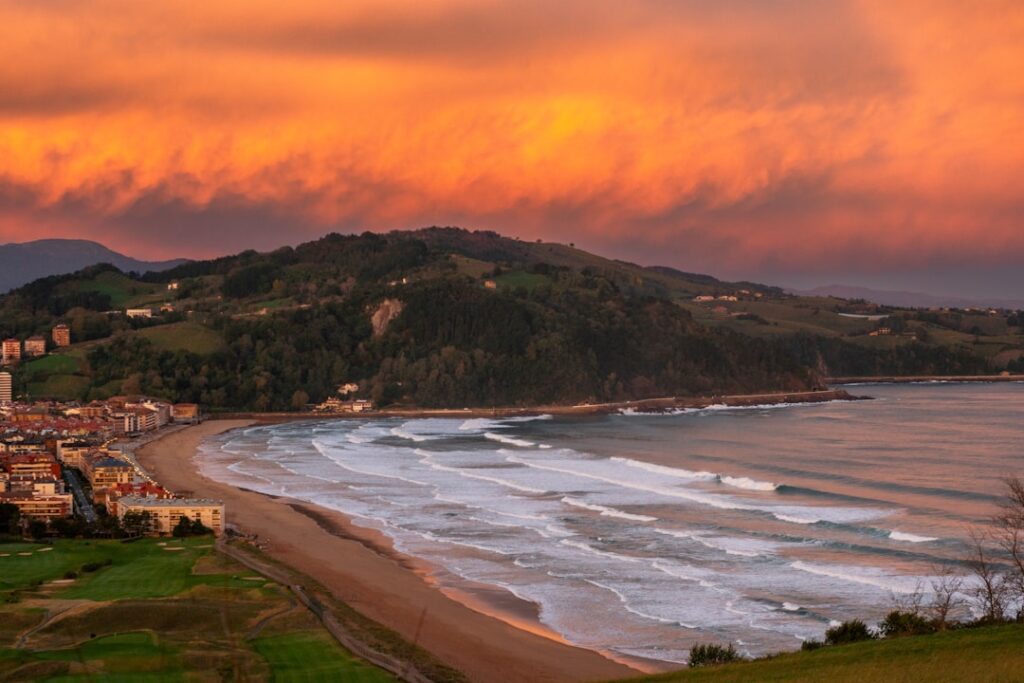
The Basque Country isn’t the first place that comes to mind when you think of Spanish beaches, but that’s exactly what makes it special. While crowds swarm the Mediterranean, this stretch of northern coastline offers something different: dramatic cliffs, emerald-green water, world-class surfing, and elegant Belle Époque beach towns where you can swim before lunch and feast on pintxos by evening.
The Atlantic is cooler here than the Mediterranean — expect water temperatures around 68–72°F in summer — but the beaches are pristine, the scenery is stunning, and you’ll have space to breathe.
La Concha: Spain’s Most Beautiful City Beach
La Concha in San Sebastián consistently ranks among Europe’s most beautiful urban beaches, and once you see it, you’ll understand why. This crescent-shaped bay curves between Monte Igueldo and Monte Urgull, with soft golden sand, calm shallow water, and the tiny island of Santa Clara sitting in the middle like a punctuation mark.
The beach runs for about a mile along the Paseo de la Concha, backed by elegant white railings and Belle Époque architecture. Arrive early in July and August if you want prime real estate on the sand — locals claim their spots by 10 a.m. The water is protected and gentle, perfect for families, though it’s refreshingly cool even in peak summer.
Rent a kayak or paddleboard to reach Santa Clara island, where there’s a small beach and a seasonal snack bar. The 200-meter swim is manageable for confident swimmers, and the views back to the city are spectacular.
Zurriola: San Sebastián’s Surf Beach
Just across the Urumea River from La Concha, Zurriola offers a completely different vibe. This is San Sebastián’s surf beach, backed by the modern Kursaal Congress Centre’s glass cubes and the hip Gros neighborhood. The waves here are consistent and beginner-friendly, with several surf schools operating right on the sand.
Pukas Surf Eskola and Zurriola Surf School rent boards and wetsuits and offer lessons for all levels. Even in August, you’ll want a wetsuit — the water stays brisk. The beach attracts a younger crowd, with volleyball nets, skateparks nearby, and a laid-back energy that contrasts with La Concha’s genteel atmosphere.
After your session, head into Gros for vermouth and pintxos at Bar Txepetxa, famous for anchovies prepared two dozen ways.
Playa de Ondarreta: The Quiet End of San Sebastián
West of La Concha, Ondarreta is San Sebastián’s most upscale beach, backed by grand homes and the Miramar Palace gardens. It’s slightly less crowded than La Concha, attracts more families, and offers the same gorgeous crescent of sand and protected swimming.
The western end sits beneath Monte Igueldo, where you can ride a funicular railway to the top for panoramic views. The eastern end connects to La Concha via a pleasant promenade walk. At low tide, you can walk across the small channel to Santa Clara island.
The Real Club Náutico sits at the beach’s western edge — not a public facility, but you can watch sailboats coming and going from the sand.
Zarautz: The Longest Beach in the Basque Country
About 15 miles west of San Sebastián, Zarautz boasts the region’s longest beach — nearly 1.5 miles of golden sand backed by a lively town that’s remained authentically Basque despite summer crowds. This is serious surf territory; Zarautz hosts international competitions and has produced world-class surfers.
The town itself is worth exploring: a medieval quarter with narrow streets, excellent restaurants, and txakoli wineries in the surrounding hills. Karlos Arguiñano, one of Spain‘s most famous chefs, runs his restaurant here — Restaurante Karlos Arguiñano is pricey but exceptional.
Zarautz is easily reached by EuskoTren, the Basque regional rail line, from San Sebastián. Trains run hourly and take about 30 minutes.
Getaria and Playa de Gaztetape: Wine Country Meets the Sea
Tiny Getaria, birthplace of explorer Juan Sebastián Elcano, clings to a rocky promontory just west of Zarautz. The town’s small beach, Playa de Gaztetape, sits in a protected cove with calm water and views of the distinctive humpbacked island called El Ratón de Getaria.
What makes Getaria special isn’t the beach itself — it’s small and gets packed in summer — but the combination of swimming, exceptional seafood, and txakoli wine. The hills above town produce some of the Basque Country’s finest txakoli at wineries like Txomin Etxaniz and Talai Berri, both offering tastings and tours.
Grill restaurants line the harbor, specializing in whole grilled turbot caught that morning. Elkano is the most famous, but Kaia-Kaipe and Iribar are equally good and slightly easier to book.
Lekeitio: Basque Fishing Village Charm
Further west into Vizcaya province, Lekeitio remains a working fishing port with two beautiful beaches and far fewer international tourists. Playa de Lekeitio sits in town, with colorful fishing boats pulled up on the sand and the Gothic church of Santa María rising behind. At low tide, you can walk across to San Nicolás island.
Playa de Karraspio, on the opposite side of the harbor, is larger and more exposed, with good waves and rockpools for exploring. The town itself is gorgeous: arcaded streets, excellent pintxos bars, and a slower pace than San Sebastián.
Lekeitio is harder to reach without a car, but buses run from Bilbao (about 90 minutes). It’s worth the effort for the authentic atmosphere and uncrowded beaches.
When to Visit
July and August offer the warmest water and most reliable weather, but beaches — especially La Concha — get very crowded. June and September provide a better balance: pleasant temperatures, quieter beaches, and still-swimmable water. Even in peak summer, mornings before 11 a.m. are relatively peaceful.
Bring a wetsuit if you’re planning to surf or swim for extended periods. Even in August, the Atlantic stays brisk, and locals often wear shorty wetsuits for comfort.
Most Basque beaches have excellent facilities: showers, changing rooms, lifeguards in summer, and nearby cafés. La Concha and Zurriola in San Sebastián also have beach libraries where you can borrow books for free — a charming local touch.
The Basque Country’s beaches won’t give you the warm Mediterranean experience of the Costa del Sol, but they offer something better: dramatic beauty, excellent waves, world-class food moments away, and the satisfaction of discovering Spain’s coast at its most authentic and least crowded.
Want more insider guides to Spain’s hidden corners and local favorites? Subscribe to the Love Spain newsletter — one short story every day, straight to your inbox.
Tours & experiences in Spain


Powered by Viator. Some links are affiliate links — we may earn a small commission at no extra cost to you.