
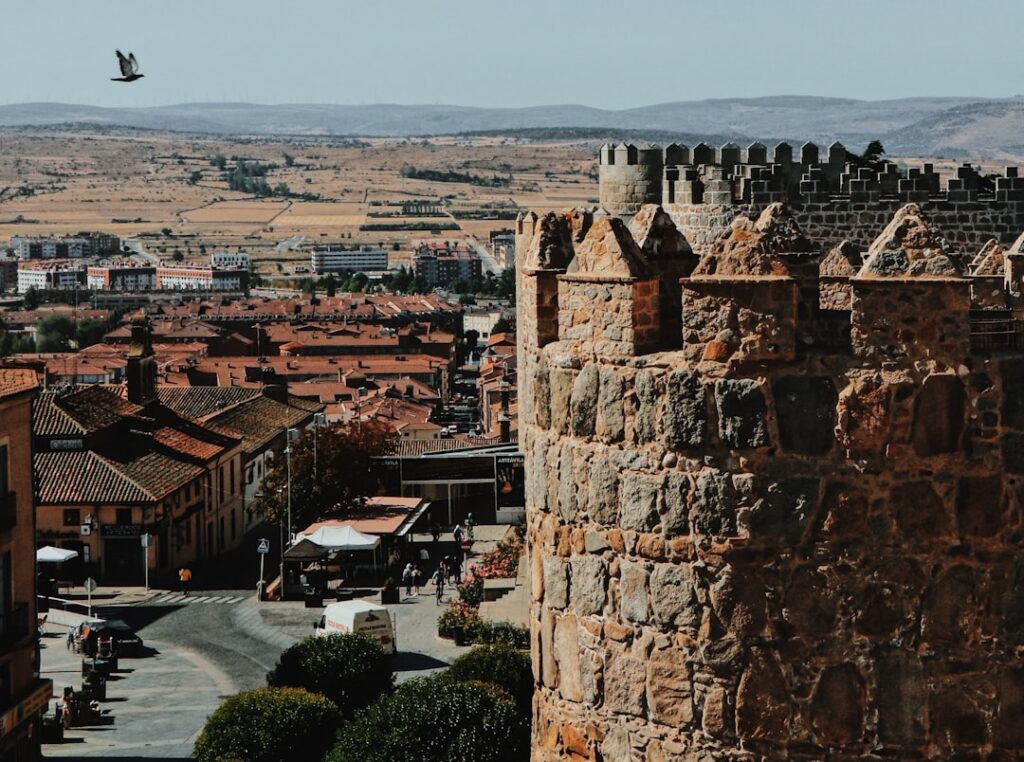
Ávila sits on a windswept plateau northwest of Madrid, its medieval walls rising above the Castilian plain like something out of a storybook. This is Spain’s highest provincial capital, and on a clear day the air feels thin and sharp. The city’s fortifications—built in the 11th and 12th centuries—remain almost entirely intact, making Ávila one of Europe’s best-preserved walled cities and a UNESCO World Heritage site.
Beyond the walls, Ávila is the birthplace of Saint Teresa of Ávila, the 16th-century mystic and reformer whose presence still shapes the city’s identity. It’s a place where stone and spirit meet, where you can walk ramparts at sunset and wander quiet convents that have stood for centuries.
Getting There and Getting Around
Ávila is about 115 kilometers northwest of Madrid, and the drive takes roughly 90 minutes via the A-6 and AP-51 toll road. But the easier option is the train: Renfe runs frequent services from Madrid’s Chamartín station, and the journey takes just over an hour and a half. Trains deposit you at Ávila’s station on the eastern edge of the old town, a fifteen-minute walk from the walls.
Once you’re inside the old quarter, everything is walkable. The historic center is compact, and the main sights cluster around the cathedral and Plaza del Mercado Chico. Wear comfortable shoes—the cobblestones are uneven, and if you climb the walls, there are stairs.
If you’re combining Ávila with Segovia in a single day, several organized tours from Madrid handle the logistics and offer guided commentary at both cities.
Walking the Walls
The murallas—Ávila’s city walls—stretch for 2.5 kilometers and include 88 towers and nine gates. You can walk sections of the ramparts from two main access points: one near the Puerta del Alcázar on the west side, the other at the Puerta de los Leales to the north. The full circuit isn’t open to the public, but the stretches you can walk offer sweeping views over the red-tiled roofs of the old town and out across the austere Castilian landscape.
Go late in the afternoon if you can. The light turns golden, the tour groups thin out, and the experience feels more intimate. Admission is modest—around €5—and includes access to interpretive displays explaining the walls’ construction and defensive history.
The best external view of the walls is from the Cuatro Postes, a small monument about a kilometer west of the city on the road to Salamanca. It’s a classic photo stop, especially at dusk when the walls are illuminated.
Saint Teresa and the Convent Trail
Saint Teresa was born in Ávila in 1515, and the city has preserved her memory with reverence. The Convento de Santa Teresa stands on the site of her childhood home, and its small chapel contains relics and the room where she was born, now converted into a baroque shrine.
More atmospheric is the Monasterio de la Encarnación, just outside the walls to the north. Teresa spent nearly three decades here as a Carmelite nun before founding her reformed order. The convent is still active, and guided tours take you through Teresa’s cell, the parlor where she spoke with Saint John of the Cross, and the museum displaying her personal effects—manuscripts, a wooden pillow, her sandals.
For a deeper dive, visit the Museo de Santa Teresa near the Puerta de la Santa, which traces her life and spiritual writings. Ávila takes its mystical heritage seriously, and even if you’re not religious, the quietude and history here are palpable.
Cathedral, Squares, and Yemas
Ávila’s cathedral doubles as part of the city’s defensive system—its apse is built into the eastern wall. Inside, the mix of Romanesque, Gothic, and Renaissance elements reflects centuries of construction. The altarpiece by Pedro Berruguete and Juan de Borgoña is a highlight, as is the alabaster tomb of Bishop Alonso de Madrigal, known as El Tostado.
After the cathedral, wander through Plaza del Mercado Chico, the main square framed by arcaded buildings and cafés. It’s a good spot to rest with a coffee and watch local life unfold.
Before you leave, pick up a box of yemas de Santa Teresa—sweet egg-yolk confections made by local convents and sold in pastry shops around town. They’re rich, intensely sweet, and a piece of Ávila’s culinary tradition.
When to Visit
Ávila sits at over 1,100 meters elevation, and the weather can be harsh. Winters are cold and windy; summers are warm but bearable thanks to the altitude. Spring and autumn are ideal—May, June, September, and October offer pleasant temperatures and fewer crowds.
Avoid major religious holidays if you prefer solitude; the city draws pilgrims year-round. Weekdays are quieter than weekends, when day-trippers from Madrid arrive in force.
Plan for four to five hours if you’re seeing the main sights at a relaxed pace. Ávila rewards slow exploration—this isn’t a place to rush.
Want more insider tips and travel stories from across Spain? Subscribe to the Love Spain newsletter and get one short story a day, straight to your inbox.
Tours & experiences in Spain


Powered by Viator. Some links are affiliate links — we may earn a small commission at no extra cost to you.