
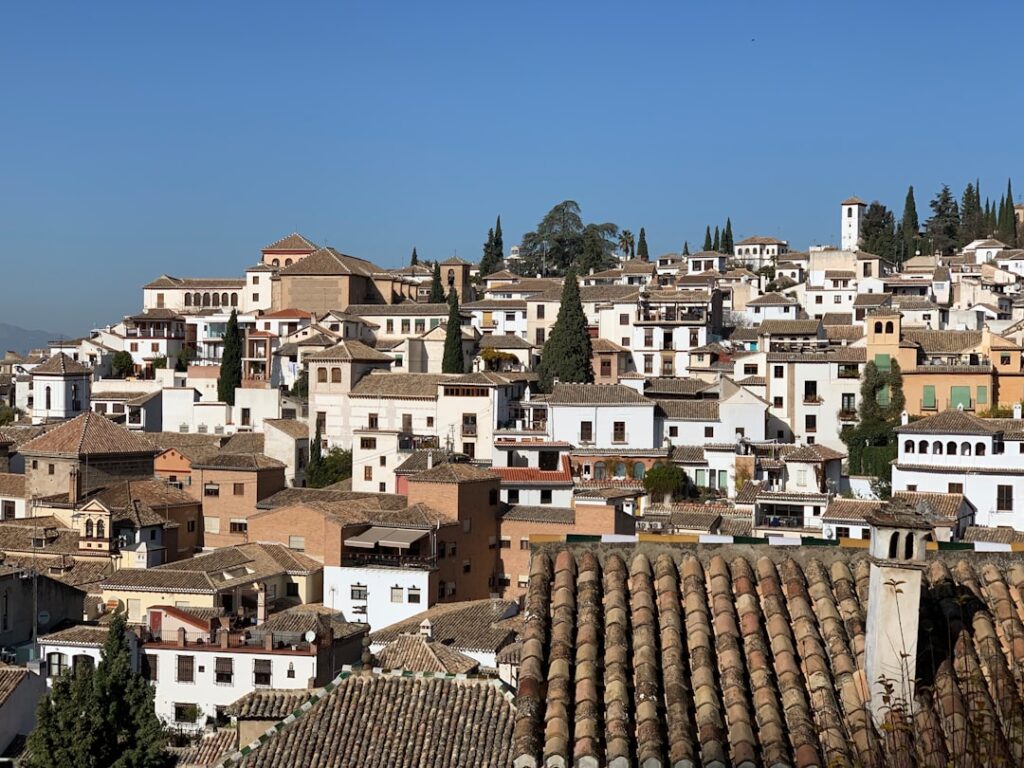
Granada rewards you for staying in the right place. This is a city of steep hills, ancient neighborhoods, and distinct personalities—where you sleep shapes what you see, how you move, and what Granada reveals to you.
Unlike sprawling Madrid or beachfront Valencia, Granada is compact but vertical. The Alhambra sits on one hill, the Albaicín climbs another, and Sacromonte clings to a third. Between them runs the modern city center. Each neighborhood offers a different lens on Granada’s layered identity: Moorish, Romani, university town, and Andalusian crossroads.
Here’s how to choose where to base yourself.
Albaicín: Moorish Lanes and Alhambra Views
The Albaicín is Granada’s old Moorish quarter, a UNESCO World Heritage site of whitewashed houses, narrow cobbled alleys, and jasmine-scented plazas. Staying here puts you in the most atmospheric part of the city, with the Alhambra glowing across the valley at sunset.
The neighborhood climbs steeply from Plaza Nueva up to the Mirador de San Nicolás, the city’s most famous viewpoint. Expect stairs, uneven cobblestones, and no traffic—most streets are pedestrian-only or too narrow for cars. It’s quiet at night, genuinely local, and full of small guesthouses and boutique hotels converted from old Arab houses, many with interior courtyards and rooftop terraces.
Stay here if you want old-world charm, don’t mind walking uphill, and value atmosphere over convenience. You’re a 15-minute walk from the Cathedral and city center, but taxis can’t always reach your door.
Best streets: Calle Pagés, Calle San Gregorio Alto, and anything near Plaza Larga, the Albaicín’s lively market square with morning fruit vendors and evening terrace bars.
Sacromonte: Cave Houses and Flamenco Roots
Sacromonte is Granada’s Romani neighborhood, famous for its cave houses carved into the hillside and its deep flamenco tradition. A handful of those caves have been converted into guesthouses—unique, atmospheric, and surprisingly comfortable, with thick white walls, terracotta tiles, and views over the valley.
This is the most remote neighborhood, perched above the Albaicín with no flat streets and limited dining options. You’re here for the experience: waking up in a cave, walking down through cactus and prickly pear to the city, and hearing flamenco drift from the zambras (flamenco caves) at night.
Stay here if you want something unusual and don’t mind being a 25-minute walk from the center (or a short taxi ride). It’s quiet, romantic, and not for everyone—but unforgettable if it suits you.
Book a cave stay through small operators like Cuevas El Abanico or Casas Cuevas La Chumbera, both family-run and authentically local.
Realejo: The Old Jewish Quarter, Quiet and Central
Realejo sits just below the Alhambra, south of the city center. It was Granada’s Jewish quarter until 1492, and today it’s a peaceful residential neighborhood of tree-lined streets, small plazas, and family-run tapas bars. You’re close to everything—walking distance to the Alhambra ticket office, the Cathedral, and the city center—without the tourist density.
This is where you stay for a local feel with easy access. The Campo del Príncipe, Realejo’s main square, fills with outdoor tables in the evening. Calle Molinos and Calle Varela are lined with excellent tapas spots. The neighborhood has a good mix of small hotels, vacation rentals, and budget hostels.
Stay here if you want a base that feels residential but keeps you within 10 minutes of major sights. It’s flat, walkable, and quietly charming.
Centro: Plaza Nueva and the Cathedral District
Granada’s city center—anchored by Plaza Nueva, the Cathedral, and the streets around Calle Reyes Católicos—is the most convenient place to stay. You’re surrounded by restaurants, shops, and transport links, with easy walks to the Alhambra, Albaicín, and Realejo.
This area is busier and less atmospheric than the historic neighborhoods, but it’s practical, especially for short stays or if you’re arriving by bus or train. Hotels range from budget chains to mid-range options on Calle Gran Vía de Colón and near Plaza Isabel la Católica.
Stay here if convenience matters more than character, or if you’re visiting in winter when the hills get cold and you want to minimize walking.
Plaza Nueva itself is the city’s transport hub, with buses to the Alhambra and taxis always waiting. The narrow streets behind the Cathedral—Calle Oficios, Calle Azacayas—hold some of the city’s best small restaurants.
How to Decide
Choose the Albaicín for atmosphere and views, but pack light and wear good shoes. Choose Sacromonte for a one-of-a-kind cave experience if you’re comfortable being outside the center. Choose Realejo for the best balance of local life and convenience. Choose Centro if you want easy access and don’t mind sacrificing some charm.
Most visitors stay three nights. If you’re staying longer, consider splitting your time—two nights in the Albaicín, one in Realejo—to experience different sides of the city.
Wherever you stay, book ahead. Granada is small, popular, and fills up quickly, especially in spring and fall when the weather is perfect and the Alhambra glows.
Want more Spain travel stories like this? Subscribe to the Love Spain newsletter—one short story a day, straight to your inbox.
Tours & experiences in Spain


Powered by Viator. Some links are affiliate links — we may earn a small commission at no extra cost to you.