
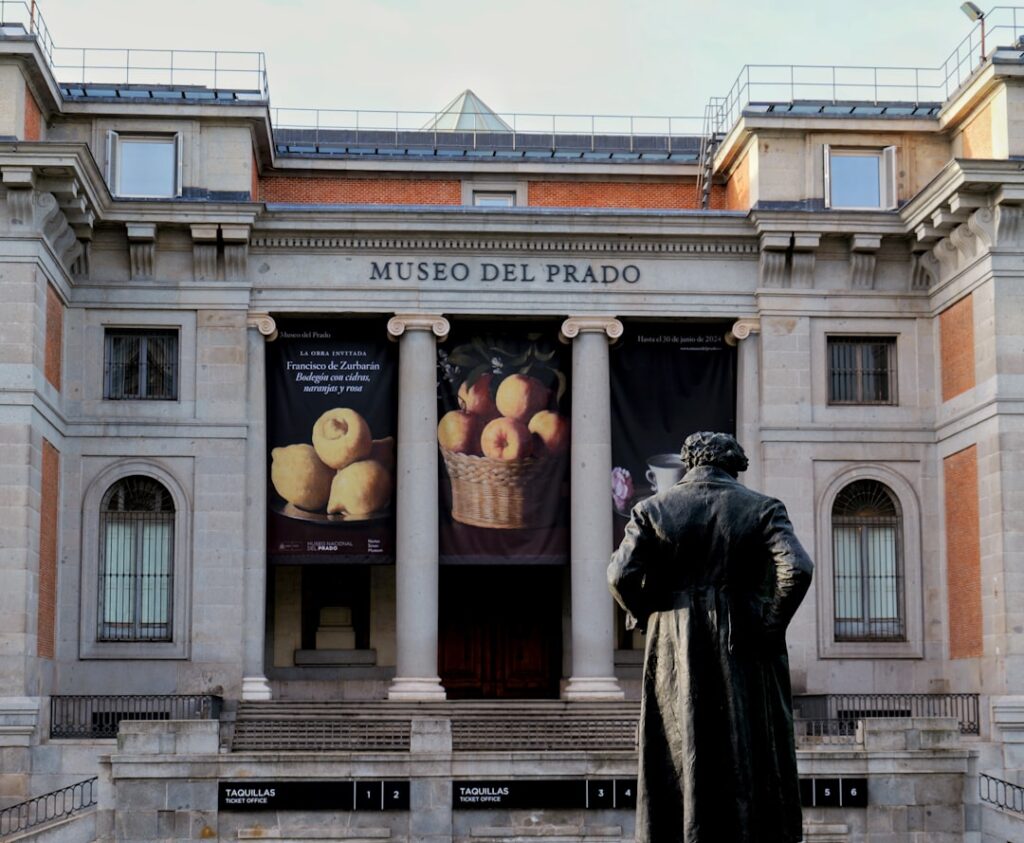
The Museo del Prado isn’t just Madrid’s most important museum—it’s one of the greatest art collections on earth. With over 8,000 paintings in its collection and roughly 1,300 on display at any time, the Prado concentrates centuries of Spanish, Flemish, and Italian masterworks under one roof. This is where you come face-to-face with Velázquez’s Las Meninas, Goya’s haunting Black Paintings, and Bosch’s fantastical triptychs.
If you’re planning a visit, a little strategy goes a long way. The Prado is vast, often crowded, and impossible to see in one go. Here’s how to make the most of your time inside Spain’s greatest art museum.
Book Tickets Early and Arrive at Opening
The Prado opens at 10 a.m. most days, and the first hour is your golden window. Crowds thin out dramatically, and you’ll have breathing room in front of the masterpieces. Book tickets online in advance—the queue at the Puerta de Goya entrance can stretch down the Paseo del Prado by mid-morning, especially in spring and summer.
Free admission is available during the final two hours of the day (6 p.m. to 8 p.m. Monday through Saturday, 5 p.m. to 7 p.m. on Sundays and holidays), but expect serious crowds and a rushed experience. If you’re serious about the art, pay the entrance fee and go early.
The museum sits on the Paseo del Prado, easily reached by metro (Banco de España or Atocha stations). The main entrances are Puerta de Goya (north side) and Puerta de Velázquez (south side). If you’ve booked online, either entrance works—just have your confirmation ready on your phone.
The Must-See Spanish Masters
Start with the Spanish painting galleries on the first floor. Room 12 holds Velázquez’s Las Meninas, arguably the most important painting in Spanish art history. The entire room is designed around this single canvas, and it’s worth sitting on the central bench for a few minutes to absorb the composition, the play of light, and Velázquez’s own self-portrait in the background.
From there, move through the adjacent Velázquez rooms (rooms 9, 10, 11, 14, 15) to see his royal portraits, including The Surrender of Breda and the haunting Christ Crucified. These galleries are never quiet, but they’re deeply rewarding.
Next, head to the Goya galleries. The evolution is striking: start with his bright, optimistic tapestry cartoons on the ground floor (room 85), then climb to the first floor for the royal portraits and The Third of May 1808, his searing depiction of war. End in rooms 66 and 67 with the Black Paintings—dark, disturbing works Goya painted directly on the walls of his home late in life. Saturn Devouring His Son is unforgettable.
Don’t skip El Greco. His elongated figures and mystical intensity dominate rooms 8B and 9B on the first floor. The Nobleman with His Hand on His Chest and The Adoration of the Shepherds show why Toledo became his creative home.
Beyond Spain: Bosch, Rubens, and Titian
The Prado’s Flemish and Italian collections rival any museum in Europe. Room 56A on the ground floor holds Bosch’s The Garden of Earthly Delights, a three-panel masterpiece of surreal imagination that draws perpetual crowds. Arrive early to see it without elbowing through a scrum.
Rubens gets an entire wing (rooms 28–29 and 75–82), with massive canvases celebrating mythology, religion, and royal propaganda. Titian’s rooms (24–27, 40–44) showcase Venetian color at its finest, including several works painted for Spanish royalty.
Practical Tips for Your Visit
Give yourself at least three hours, though you could easily spend a full day. The museum has a solid café near the Jerónimos entrance if you need a break—coffee and a sandwich will reset your feet and your focus.
Photography is not allowed inside the galleries, so put the phone away and just look. The Prado takes this rule seriously, and guards will stop you immediately.
If you’re visiting in summer, the museum is blissfully air-conditioned—a bonus after walking Madrid’s hot streets. In winter, the building can feel cool in the early morning; bring a light layer.
The museum shop near the Velázquez entrance has excellent books and prints. If a particular painting strikes you, this is where to find a high-quality reproduction.
Combine Your Visit with the Paseo del Arte
The Prado anchors Madrid’s “Golden Triangle of Art” along the Paseo del Prado. The Reina Sofía (home to Picasso’s Guernica) is a 10-minute walk south, and the Thyssen-Bornemisza is just across the boulevard. A combined ticket covers all three museums and saves a few euros, but trying to see them all in one day is a recipe for exhaustion. Pick two at most.
After the Prado, the nearby Retiro Park is perfect for decompressing. Grab a coffee at one of the park’s terraces or wander through the rose gardens. The combination of world-class art and green space makes this corner of Madrid unbeatable.
Want more insider tips on Spain’s cities, food, and culture? Subscribe to the Love Spain newsletter—one short story a day, straight to your inbox.
Tours & experiences in Spain


Powered by Viator. Some links are affiliate links — we may earn a small commission at no extra cost to you.