
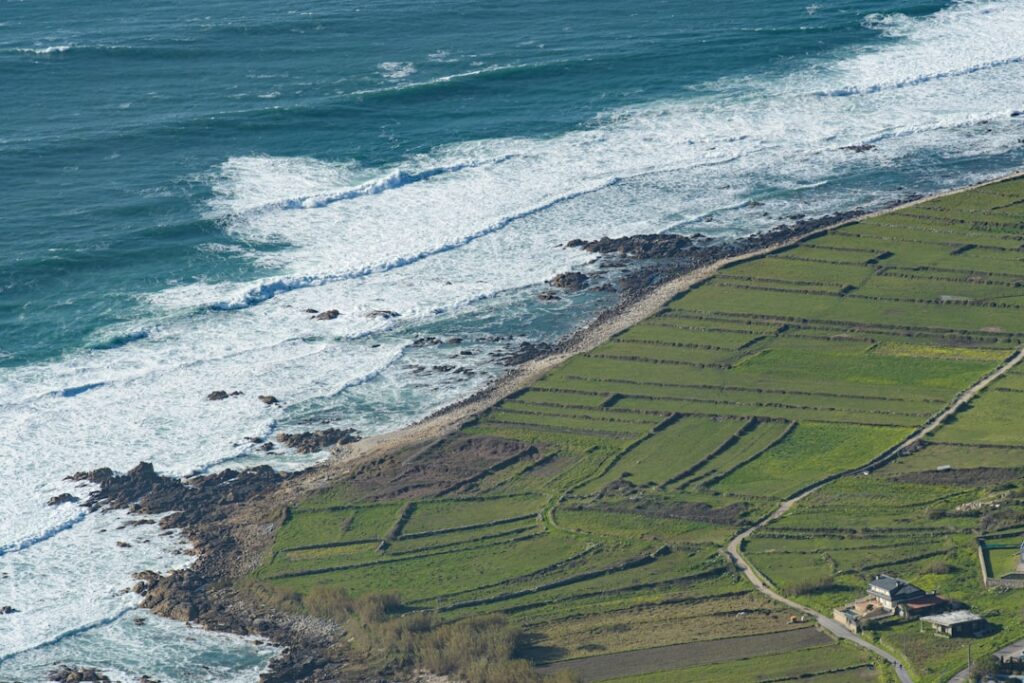
Galicia doesn’t look like the Spain most travelers expect. The northwestern region trades whitewashed villages and olive groves for green hillsides, granite farmhouses, and a coastline carved into a hundred inlets. Rain falls here more often than sunshine, the Atlantic crashes against cliffs instead of lapping at Mediterranean coves, and the local language shares more with Portuguese than Castilian Spanish.
This is Spain’s Celtic corner, where bagpipes accompany festivals, seafood defines the cuisine, and the Camino de Santiago has drawn pilgrims for more than a thousand years. If you’ve already done Andalusia and Barcelona, Galicia offers something entirely different.
Santiago de Compostela and the Camino
Santiago de Compostela remains Galicia’s spiritual and cultural heart. The cathedral in the old town marks the end point of the Camino de Santiago, where pilgrims arrive after walking hundreds of miles across northern Spain. Even if you’re not hiking the full route, the city rewards a few days of exploration.
The cathedral itself dominates the Praza do Obradoiro, its baroque facade rising above worn stone squares where pilgrims collapse in tears or celebration. Inside, the Pórtico da Gloria displays some of medieval Europe’s finest sculpture. Arrive for the daily noon pilgrim’s mass if you want to see the botafumeiro, a giant thurible swung on ropes across the transept—though it only appears on major feast days and isn’t guaranteed.
The old town spreads out in narrow lanes lined with granite buildings, tapas bars serving pulpo a feira (octopus with paprika and olive oil), and small plazas where university students gather in the evenings. Walk Rúa do Franco for seafood restaurants and wine bars. Stay near the cathedral if you want to hear the morning bells, or book in the newer town south of the center for lower prices and local life.
The Rías Baixas: Galicia’s Best Coastline
Galicia’s coastline fractures into rías—deep inlets that function like fjords, sheltering fishing villages and producing some of Spain’s best seafood. The Rías Baixas in the south offer the most accessible beaches and the region’s famous Albariño wine.
Combarro, just outside Pontevedra, lines its waterfront with hórreos—raised granite granaries that have stored corn for centuries. The village remains small enough to walk in an hour, with seafood restaurants overlooking the ría. Order percebes (goose barnacles) if you see them on the menu—they’re harvested by hand from rocks pounded by Atlantic surf and taste like the ocean concentrated into one bite.
Further south, the town of Cambados sits at the heart of Albariño country. The white wine produced here pairs perfectly with Galicia’s seafood. Visit a few bodegas around town—most offer tastings without reservations—then have lunch at any marisquería serving shellfish pulled from the ría that morning.
For beaches, head to the Cíes Islands off Vigo. The archipelago forms part of the Atlantic Islands of Galicia National Park, with white sand beaches and turquoise water that rival the Mediterranean. Ferries run from Vigo during summer months, and daily visitor numbers are capped to protect the environment. Book ahead.
A Coruña and the Northern Coast
A Coruña anchors Galicia’s northern coast with a working port city that manages to feel both historic and lived-in. The old town centers on the Plaza de María Pita, named for the local heroine who helped defend the city against Francis Drake’s English fleet in 1589.
Walk the waterfront promenade past the glazed balconies that give the city its nickname, the “Crystal City.” These white galleries reflected sunlight into dark apartments in the 19th century and now define A Coruña’s architectural character. At the end of the peninsula, the Tower of Hercules has guided ships since Roman times—it’s the world’s oldest working lighthouse and worth the climb for views across the Atlantic.
For seafood, the neighborhoods around Calle de la Franja and the port serve the city’s best restaurants. Order navajas (razor clams), zamburiñas (tiny scallops), and local beer. Skip the hotel restaurant; locals eat late and well in the old town.
When to Visit Galicia
Summer brings the most reliable weather, though Galicia never gets truly hot and rain remains possible year-round. July and August see crowds along the coast and in Santiago, but the region absorbs visitors better than southern Spain. May, June, and September offer good weather with fewer tourists.
The Camino de Santiago peaks in summer, particularly the final 100 kilometers into Santiago. If you’re walking any portion of the route, spring or fall provides cooler temperatures and quieter trails.
Winter turns Galicia green and wet. Coastal storms can be dramatic, and while cities like Santiago and A Coruña function normally, beach towns and rural areas quiet down. The seafood remains excellent, and you’ll have the cathedrals largely to yourself.
Trains connect Santiago, A Coruña, Pontevedra, and Vigo with reasonable frequency. Renting a car opens up the coast and small villages, though Galician roads wind through hills and take longer than the map suggests. The Atlantic waits.
Want more stories from Spain’s hidden corners? Subscribe to the Love Spain newsletter—one short story a day about the country beyond the guidebooks.
Tours & experiences in Spain


Powered by Viator. Some links are affiliate links — we may earn a small commission at no extra cost to you.