
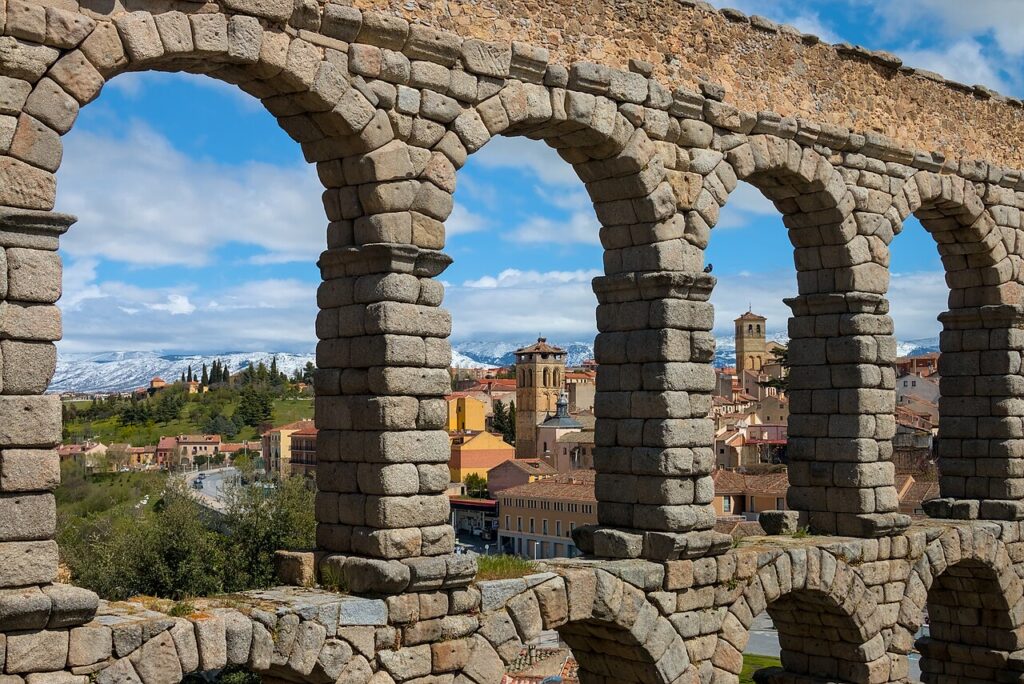
Segovia sits on a rocky ridge in the Castilian countryside, less than an hour northwest of Madrid by train or car. It’s small enough to walk in an afternoon, but packed with enough history and architecture to make it one of the best day trips in central Spain. The Roman aqueduct alone justifies the journey—but add a castle straight out of a fairy tale, a cathedral with soaring Gothic lines, and some of the best roast suckling pig in the country, and you have a destination that feels too good to be true.
The medieval city has been a UNESCO World Heritage Site since 1985, and once you arrive, you’ll understand why. Stone streets wind past honey-colored buildings, church towers rise above tiled rooftops, and views stretch out over the Sierra de Guadarrama. It’s the kind of place where every corner looks like a postcard, but without the crowds you’ll find in Toledo or Granada.
The Aqueduct: Rome’s Greatest Engineering Feat in Spain
The Acueducto de Segovia dominates the Plaza del Azoguejo, towering 28 meters above the cobblestones. Built in the first century AD without a single drop of mortar, this 800-meter structure brought water from the Río Frío to the walled city for nearly 2,000 years. Over 20,000 granite blocks, stacked with precise Roman engineering, still stand as solid as the day they were placed.
Stand beneath the arches and look up—the scale is staggering. The aqueduct is best seen early in the morning or late afternoon when the light hits the stone and the plaza is quieter. Climb the stairs to Calle Cervantes for an elevated view that shows the full span cutting through the old town.
Avoid the souvenir stalls in the plaza and head straight up Calle de Cervantes into the historic quarter. The walk takes you past the Casa de los Picos, a 15th-century mansion with a facade covered in diamond-shaped stones that looks like it’s been studded with pyramids.
The Alcázar: Spain’s Most Dramatic Castle
At the western tip of the old town, the Alcázar de Segovia rises from a narrow ridge where the Eresma and Clamores rivers meet far below. With its cone-topped towers and sheer stone walls, it’s said to have inspired Walt Disney’s Cinderella Castle—and one look at the profile makes that claim entirely believable.
The castle dates back to the 12th century, though it’s been rebuilt and expanded many times. Inside, you’ll find the throne room where Isabella I was proclaimed Queen of Castile in 1474, along with Moorish-influenced ceilings, medieval armor, and royal portraits. The real highlight is climbing the Torre de Juan II—152 narrow, spiraling steps that reward you with 360-degree views over Segovia’s rooftops and the mountains beyond.
Tickets are inexpensive and lines are usually manageable outside of summer weekends. Buy the combined ticket that includes the tower—it’s worth every step.
The Cathedral and the Old Jewish Quarter
Segovia’s cathedral, built between 1525 and 1768, is one of the last great Gothic cathedrals constructed in Spain. Its tall spires and honey-colored stone dominate the Plaza Mayor, and the interior is surprisingly light and airy for a building of this style. The cloister, transferred from an earlier cathedral destroyed in a 16th-century revolt, is peaceful and worth a few minutes.
From the cathedral, wander into the old Jewish quarter along Calle de la Judería Vieja. Before the expulsion of 1492, Segovia had one of Spain’s most important Jewish communities. Today, the narrow streets and small plazas retain a quieter, more intimate feel than the main tourist routes. Stop by the Centro Didáctico de la Judería on Calle de la Judería to learn more about Segovia’s Sephardic history.
Where to Eat: Cochinillo Asado and More
Segovia is famous for cochinillo asado—roast suckling pig, cooked slowly in wood-fired ovens until the skin is crackling and the meat falls off the bone. The most famous spot is Mesón de Cándido, right beside the aqueduct, where the owners theatrically cut the pig with the edge of a plate to prove its tenderness. It’s touristy, but the cochinillo is legitimate. For a slightly less hectic experience, try José María on Calle Cronista Lecea or Restaurante Duque, also near the plaza.
If pork isn’t your thing, Segovian lamb (cordero asado) is another local specialty, roasted with the same care and equally worth ordering. Pair either with a bottle of Ribera del Duero from nearby wineries.
For a lighter bite, grab a table at Café Jeyma on Plaza Mayor and order their ponche segoviano, a local dessert made with sponge cake, marzipan, and a rum glaze that’s richer than it sounds.
Getting There and Practical Tips
Segovia is 90 kilometers from Madrid. The fastest option is the high-speed AVE train from Madrid Chamartín, which takes just 27 minutes to Segovia-Guiomar station. From there, catch city bus line 11 into the historic center—it drops you near the aqueduct in about 15 minutes. Alternatively, regional trains from Madrid Chamartín arrive at the old Segovia station, a scenic 20-minute walk or short bus ride from the center.
If you’re driving, take the AP-61 toll road—it’s a straight shot and parking is available near the aqueduct, though spaces fill up by midday on weekends.
Segovia works perfectly as a half-day trip, but if you have time, combine it with nearby Ávila for a full day exploring Castile’s medieval gems. Several tours from Madrid cover both cities in one day, including the Medieval Small Group Segovia and Toledo Trip from Madrid and the Madrid to Avila & Segovia: Full-Day Highlights Tour offered by Viator, both of which handle transport and give you guided context at each stop.
Summer can be hot and crowded—spring and fall offer better weather and fewer tour groups. Arrive early if you’re day-tripping; the light is better, the streets are quieter, and you’ll have your pick of tables for lunch.
Want more insider tips and hidden corners of Spain delivered to your inbox? Subscribe to the Love Spain newsletter—one short story a day, straight from the streets, kitchens, and back roads we love most.
Heads up — some links in this article are affiliate links. If you sign up through them, we may earn a small commission at no extra cost to you. We only recommend tools we use ourselves.
Tours & experiences in Spain


Powered by Viator. Some links are affiliate links — we may earn a small commission at no extra cost to you.