
Barcelona dominates the Catalonia conversation, but the region’s most memorable experiences often happen in the hills, along the coast, and in medieval towns where you’ll hear more Catalan than English. Catalonia’s diversity—Roman ruins, Pyrenean peaks, seaside monasteries, and Modernista wine cellars—rewards travelers who venture beyond the city limits.
The region is compact and well-connected by train and car. Most destinations sit within two hours of Barcelona, making them ideal for overnight trips or multi-day loops through Catalonia’s varied landscapes.
Girona: Medieval Walls and Jewish History
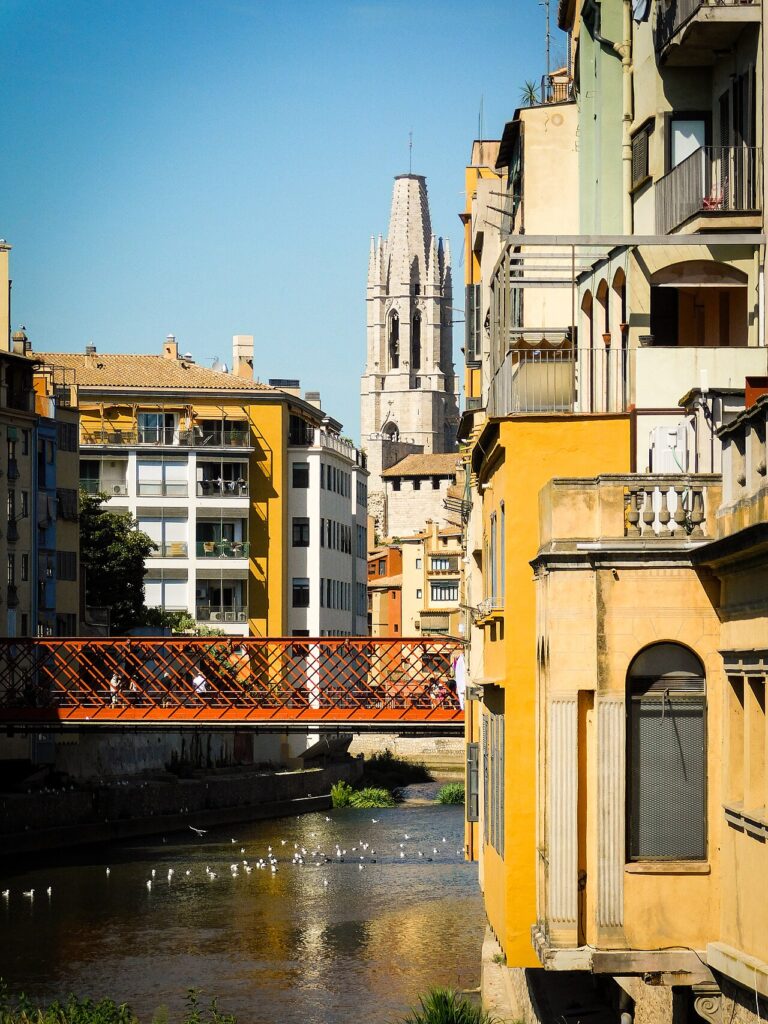
Girona’s Old Quarter, a tangle of stone steps and cobbled lanes, feels frozen somewhere between the 12th and 15th centuries. Walk the Passeig de la Muralla, the medieval city wall, for rooftop views over terracotta and the Onyar River. The houses lining the water—painted in ochre, peach, and faded red—are Girona’s postcard image, but the real draw is what lies behind them.
The Call, Girona’s Jewish Quarter, is one of Europe’s best-preserved. Carrer de la Força, the main artery, leads to the Museum of Jewish History, housed in the old synagogue. The exhibition traces Sephardic life before the 1492 expulsion. Nearby, the Arab Baths (actually Romanesque, despite the name) and the Cathedral—reached by a dramatic 90-step baroque staircase—anchor the upper town.
Girona sits 40 minutes from Barcelona by high-speed train. Stay overnight to explore the restaurants around Plaça Independència, where locals gather for evening vermut.
Montserrat: The Mountain Monastery
The jagged peaks of Montserrat, an hour northwest of Barcelona, house Catalonia’s spiritual heart. The Benedictine monastery of Santa Maria de Montserrat clings to the mountainside at 4,000 feet, home to La Moreneta—the Black Madonna—a 12th-century wooden sculpture and Catalonia’s patron saint.
Most visitors come on day trips via the rack railway from Monistrol de Montserrat, but the mountain rewards longer stays. Hike the trails to Sant Jeroni summit (4,055 feet) for views across Catalonia to the Pyrenees, or walk to the hermitages scattered among the rock formations. The Escolania, one of Europe’s oldest boys’ choirs, sings daily at 1 p.m. in the basilica—arrive early for a seat.
Pack layers. The temperature drops significantly on the mountain, even in summer, and afternoon fog can roll in without warning.
Tarragona: Rome on the Mediterranean
Tarragona, 90 minutes south of Barcelona by train, was the Roman Empire’s Tarraco—capital of Hispania Tarraconensis and one of Rome’s most important Mediterranean cities. The ruins here rival anything outside Italy.
Start at the Roman Amphitheatre, built into the hillside overlooking the sea, where gladiators fought in the 2nd century. Walk up to the Circus, where chariot races once entertained 30,000 spectators. The vaults beneath the circus now house medieval homes and shops—a palimpsest of Tarragona’s layered history.
The Passeig Arqueològic, a walkway along the 3rd-century BC walls, circles the old town. For lunch, head to the Serrallo fishing quarter, where restaurants serve suquet de peix (Catalan fish stew) and platters of grilled prawns straight off the boats.
Tarragona’s Roman ruins are UNESCO-listed and less crowded than Barcelona’s attractions. Visit in spring or fall when the heat is manageable for walking the archaeological route.
Cadaqués and the Costa Brava
Cadaqués, tucked into a rocky cove on Catalonia’s northern coast, was Salvador Dalí’s summer retreat and remains the Costa Brava’s most beautiful village. White-washed houses climb the hillside, and fishing boats still work from the pebbly beach. The light here—sharp, Mediterranean, relentless—attracted Picasso, Miró, and Duchamp long before the tourists arrived.
Visit the Casa-Museu Salvador Dalí in nearby Portlligat, the artist’s home for 50 years. Book tickets weeks in advance—visits are timed and limited. The house, a labyrinth of whitewashed rooms and stuffed swans, reveals Dalí’s domestic surrealism.
Cadaqués has no train station. Drive from Barcelona (two and a half hours) via Figueres, or take the bus from Figueres after visiting the Dalí Theatre-Museum. Stay overnight—the town empties after day-trippers leave, and the evening paseo along the waterfront is when locals reclaim their village.
Vic: Market Town in the Pyrenean Foothills
Vic, an hour north of Barcelona, hosts Catalonia’s finest food market every Tuesday and Saturday in the arcaded Plaça Major. Vendors sell embotits (Catalan cured meats), mountain cheeses, seasonal mushrooms, and mongetes (white beans) from nearby farms. It’s a working market, not a tourist attraction, though visitors are welcome to sample and buy.
Beyond market day, Vic’s medieval core holds a surprising Roman temple, a Gothic cathedral with murals by Josep Maria Sert, and pastry shops selling tortell, a local almond cake. The town makes an excellent base for exploring the Pyrenean foothills and rarely appears on tourist itineraries.
Practical Notes
Catalonia’s train network, operated by Renfe and FGC, connects Barcelona to most regional destinations. Girona, Tarragona, and Figueres sit on high-speed AVE routes; Vic and Montserrat require regional trains. Cadaqués and smaller coastal towns need a car or bus.
Spring (April to June) and fall (September to October) offer the best weather for exploring. Summer brings crowds to coastal areas, while inland towns stay quiet. Winter is mild in Tarragona and along the coast, but mountain areas can be cold and foggy.
Don’t try to see everything in one trip. Choose two or three destinations and give each a full day. Catalonia’s pleasures—medieval stone, Roman history, mountain air, coastal light—reveal themselves slowly.
Want more insider tips on Spain’s regions and hidden corners? Subscribe to the Love Spain newsletter and get one short story a day, delivered straight to your inbox.
Tours & experiences in Spain


Powered by Viator. Some links are affiliate links — we may earn a small commission at no extra cost to you.