
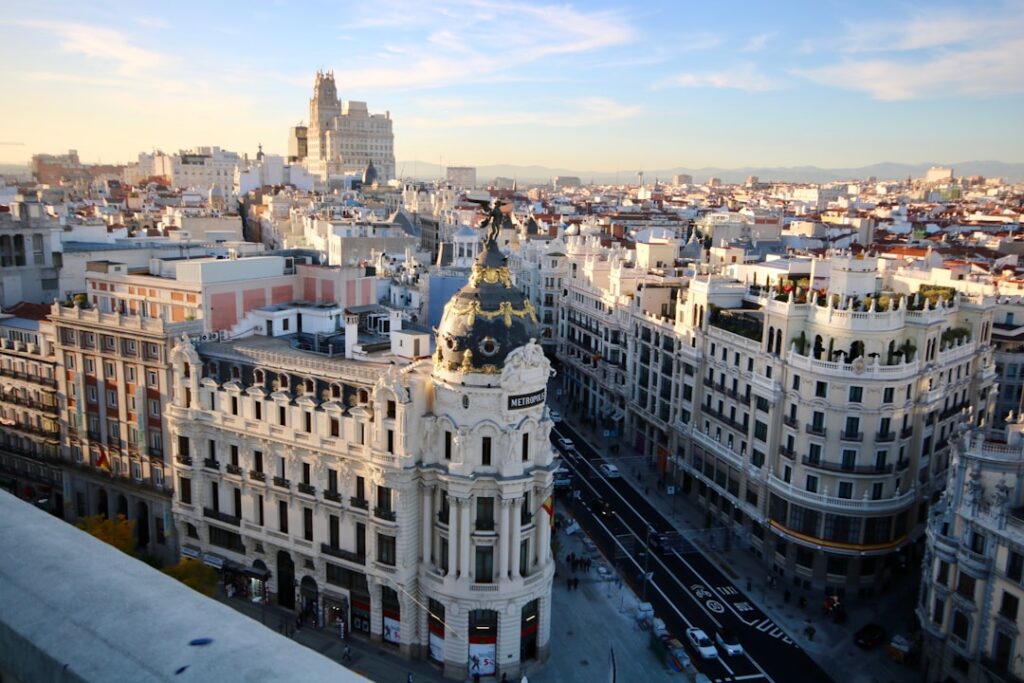
Madrid doesn’t have a single tourist center—it has half a dozen distinct neighborhoods, each with its own rhythm, character, and appeal. Where you stay determines whether you wake up to museum queues or market vendors, whether you’re steps from the Royal Palace or the city’s best vermouth bars.
The right neighborhood depends on what you want from Madrid. Here’s how to choose.
Sol and Gran Vía: The Heart of It All
Puerta del Sol sits at kilometer zero of Spain’s road network, and it feels like it. This is Madrid’s literal and figurative center—always awake, always moving, and walking distance to nearly everything a first-timer wants to see.
Stay here if you want the Prado, Retiro Park, the Royal Palace, and Plaza Mayor all within a 20-minute walk. Gran Vía, Madrid’s Broadway, runs west from Sol with theaters, shopping, and rooftop bars. The trade-off? It’s loud, crowded, and packed with chain restaurants. But the metro connections are unbeatable, and you can stumble home from anywhere in the city.
Book a hotel on the quieter side streets off Calle Arenal or near Plaza Santa Ana for a better night’s sleep without sacrificing location.
La Latina and Lavapiés: Tapas, Markets, and Real Madrid
Cross Plaza Mayor and head downhill into La Latina, and you’ll find the Madrid locals actually live in. This is the city’s oldest neighborhood—narrow medieval streets, Sunday flea markets at El Rastro, and more tapas bars per block than anywhere else in Spain.
Calle Cava Baja is the main artery, lined with traditional taverns serving croquetas, jamón, and Ribera del Duero by the glass. On Sundays, the entire neighborhood spills into the streets for vermouth and conversation. It’s festive, social, and utterly Spanish.
Just east, Lavapiés is grittier and more multicultural—Moroccan tea shops next to indie bookstores, experimental theater, and some of the city’s best value eating. It’s gentrifying but still authentic, with an edge that appeals to younger travelers and anyone tired of postcard Spain.
Both neighborhoods have fewer hotels than Sol, but plenty of vacation rentals. You’ll need to metro or walk to the big museums, but you’re living like a Madrileño.
Salamanca: Elegance and Shopping
If La Latina is old Madrid, Salamanca is polished Madrid—wide avenues, 19th-century apartment buildings, designer boutiques, and Michelin-starred restaurants. This is where well-heeled locals live, shop, and take their morning coffee in pristine cafés.
The neighborhood runs northeast from Retiro Park, centered on Calle de Serrano and Calle de Goya. You’re close to smaller, excellent museums like the Lázaro Galdiano and the Sorolla, and it’s a pleasant walk through the park to the Prado.
Salamanca is quiet, safe, and sophisticated. Stay here if you value calm evenings, excellent restaurants, and a more residential feel. It’s not cheap, but the quality is consistently high.
Malasaña and Chueca: Nightlife and Counter-Culture
North of Gran Vía, these twin neighborhoods are Madrid’s creative and social heart. Malasaña is scruffy, bohemian, and fiercely proud of its counter-culture roots—vintage shops, dive bars, and late-night bocadillo stands. Chueca, just east, is the center of Madrid’s LGBTQ+ scene, with cocktail bars, brunch spots, and the city’s best nightlife energy.
Both neighborhoods wake up late. Don’t expect much action before noon, but from evening onward, the streets hum. Plaza del Dos de Mayo in Malasaña and Plaza de Chueca are prime people-watching spots, surrounded by tapas bars and terraces.
You’re a 10-minute walk from Gran Vía and well-connected by metro. Stay here if you’re in Madrid for the social scene, the food, and the feeling that you’re somewhere that hasn’t been sanded down for tourists.
Retiro and the Museum District
If you’re in Madrid for art and quiet mornings, base yourself near Retiro Park. The Prado, Reina Sofía, and Thyssen-Bornemisza museums form the so-called Golden Triangle along Paseo del Prado, and the park itself is Madrid’s green lung—rowboats on the lake, the Crystal Palace, and shaded paths perfect for an early walk.
The area around Atocha station and Calle de Atocha has good mid-range hotels, easy train connections, and a residential calm that makes it easy to forget you’re in a capital city. You’ll need to venture into La Latina or Malasaña for nightlife, but if your Madrid centers on museums, markets, and morning runs in the park, this is your neighborhood.
Getting Around
Madrid’s metro is fast, clean, and connects every neighborhood in this guide within minutes. Forget taxis for cross-town trips—buy a 10-ride metro pass and you’re set. Most of central Madrid is also walkable, and you’ll see more on foot than underground.
No matter where you stay, you’re never far from a great meal, a world-class museum, or a plaza full of life. That’s the beauty of Madrid—every neighborhood delivers something different, but they all feel like the center of the world.
Want more insider tips on Spain’s cities, regions, and hidden corners? Subscribe to the Love Spain newsletter and get one short story a day, straight to your inbox.
Tours & experiences in Spain


Powered by Viator. Some links are affiliate links — we may earn a small commission at no extra cost to you.