
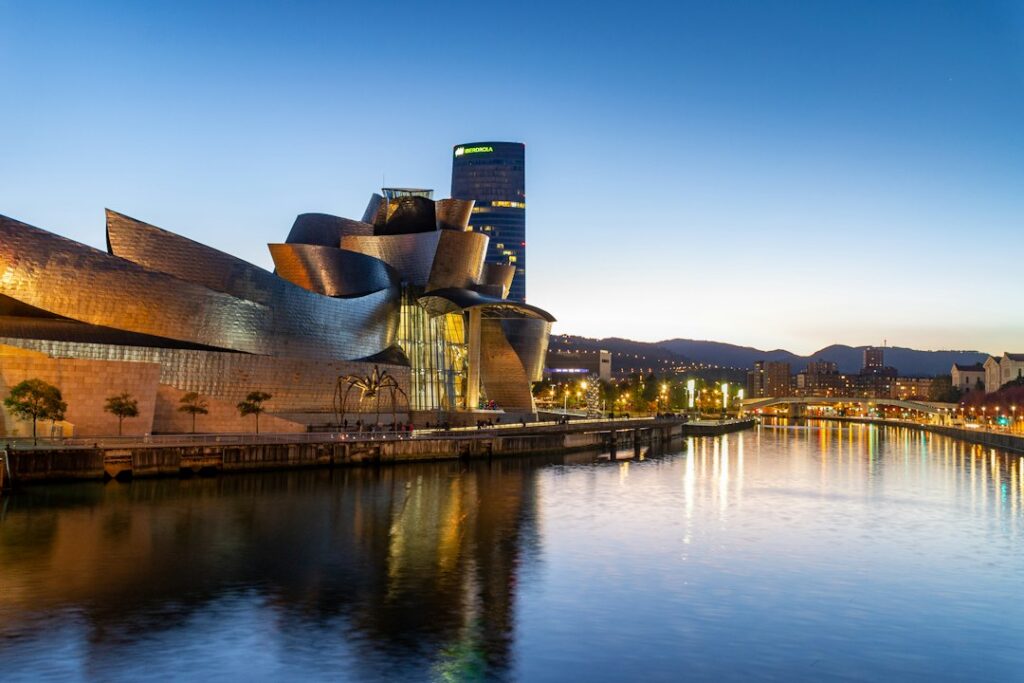
The Guggenheim Museum Bilbao doesn’t just sit in the city — it transformed it. Since opening in 1997, Frank Gehry’s swooping titanium sculpture has become Spain’s most dramatic piece of contemporary architecture and one of the world’s most recognizable museums. But the building is only half the story. Inside, you’ll find rotating exhibitions of modern and contemporary art that make this one of Europe’s most exciting museum experiences.
Here’s how to visit without missing anything important.
Getting Your Tickets
Buy tickets online at least a day ahead, especially from May through October and on weekends year-round. The museum caps daily visitors, and tickets often sell out by midday. Adult admission is €16; students and seniors pay €9. Children under 12 enter free.
Audio guides cost €6 and are worth it — they cover both the building’s architecture and the permanent collection. Tours in English run twice daily at 11 a.m. and 5 p.m., included with admission.
The museum opens at 10 a.m. Tuesday through Sunday (closed Mondays except in July and August). Arrive right at opening or after 3 p.m. to avoid the tour-bus crowds that pack the galleries between noon and 2 p.m.
What to See Inside
Start with the Atrium, Gehry’s soaring central space where natural light pours through glass walls and titanium curves create impossible angles. It’s the museum’s heart, and most galleries radiate from here across three levels.
The permanent collection focuses on postwar art. Look for Richard Serra’s The Matter of Time in Gallery 104 — eight massive steel sculptures you can walk through, disorienting and powerful. This room was built specifically for Serra’s work, and it’s the museum’s signature installation.
Galleries 101 and 102 rotate selections from the Guggenheim’s collection: expect Rothko, de Kooning, Warhol, and Basquiat alongside Spanish contemporaries like Eduardo Chillida and Antonio Saura. Gallery 105 usually features large-scale installations or video art.
The second floor holds temporary exhibitions — the museum mounts three or four major shows each year, from retrospectives of single artists to thematic surveys. Check the website before you visit to see what’s on.
Don’t miss the exterior. Jeff Koons’s Puppy, a 40-foot-tall West Highland Terrier made of flowers, guards the entrance. Walk down to the riverfront promenade for the full view of Gehry’s design and Louise Bourgeois’s bronze spider sculpture, Maman, on the plaza.
Where to Eat Nearby
The museum café is overpriced and underwhelming. Instead, walk five minutes into the Abando neighborhood.
Head to Café Iruña on Jardines de Albia, a belle-époque gem with Moorish tilework where locals have taken coffee since 1903. For pintxos, cross the Puente de la Salve to Marzana on Calle Licenciado Poza — counter piled with creative bites, €3 to €5 each. If you want a proper meal, reserve at Etxanobe on Avenida Abandoibarra, two blocks from the museum, for modern Basque cuisine with Guggenheim views from the tenth floor.
Practical Tips
The museum sits on the south bank of the Nervión River, a 20-minute walk from Casco Viejo or a quick ride on the Bilbao Metro to Moyua station. Tram line A1 stops right in front.
Photography is allowed in most galleries but not during temporary exhibitions — check signs at each entrance. No flash, no tripods.
Skip the museum shop unless you’re hunting for architecture books. The selection is good, but prices are steep.
If you’re visiting between June and September, the museum stays open until 8 p.m. — late afternoon light on the titanium exterior is spectacular, and evening visits are far less crowded.
Combine your visit with a walk along the riverside promenade to the Zubizuri bridge, Santiago Calatrava’s white wishbone arch, ten minutes east. The contrast between Gehry’s curves and Calatrava’s angles shows off Bilbao’s architectural ambition.
Want more insider tips on Spain’s best museums, hidden neighborhoods, and where to eat like a local? Subscribe to the Love Spain newsletter — one short story a day, straight to your inbox.
Tours & experiences in Spain


Powered by Viator. Some links are affiliate links — we may earn a small commission at no extra cost to you.