
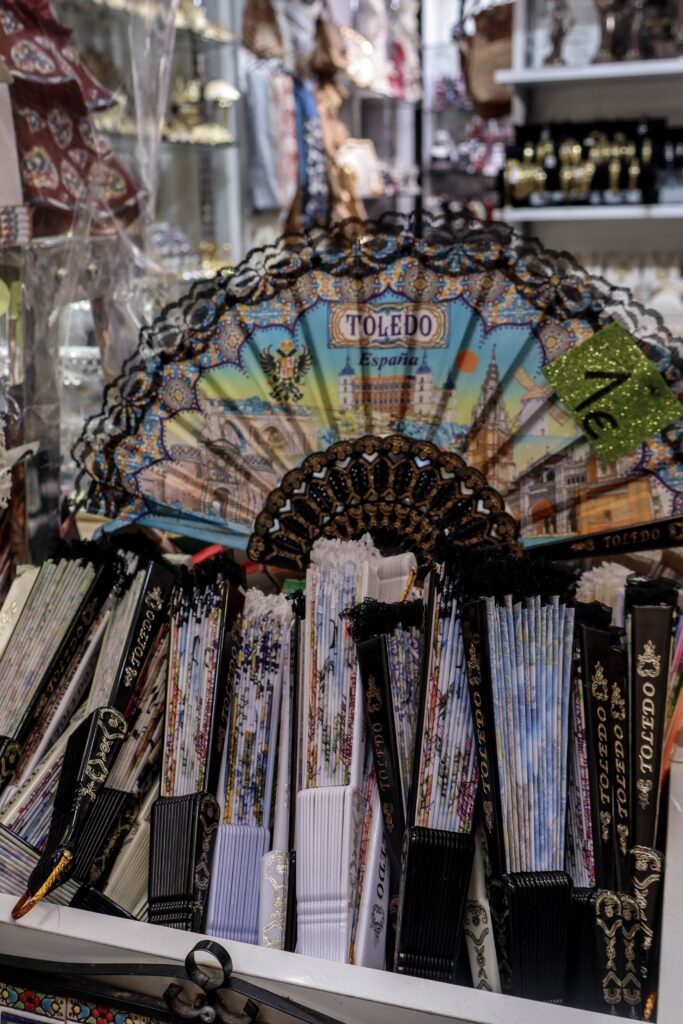
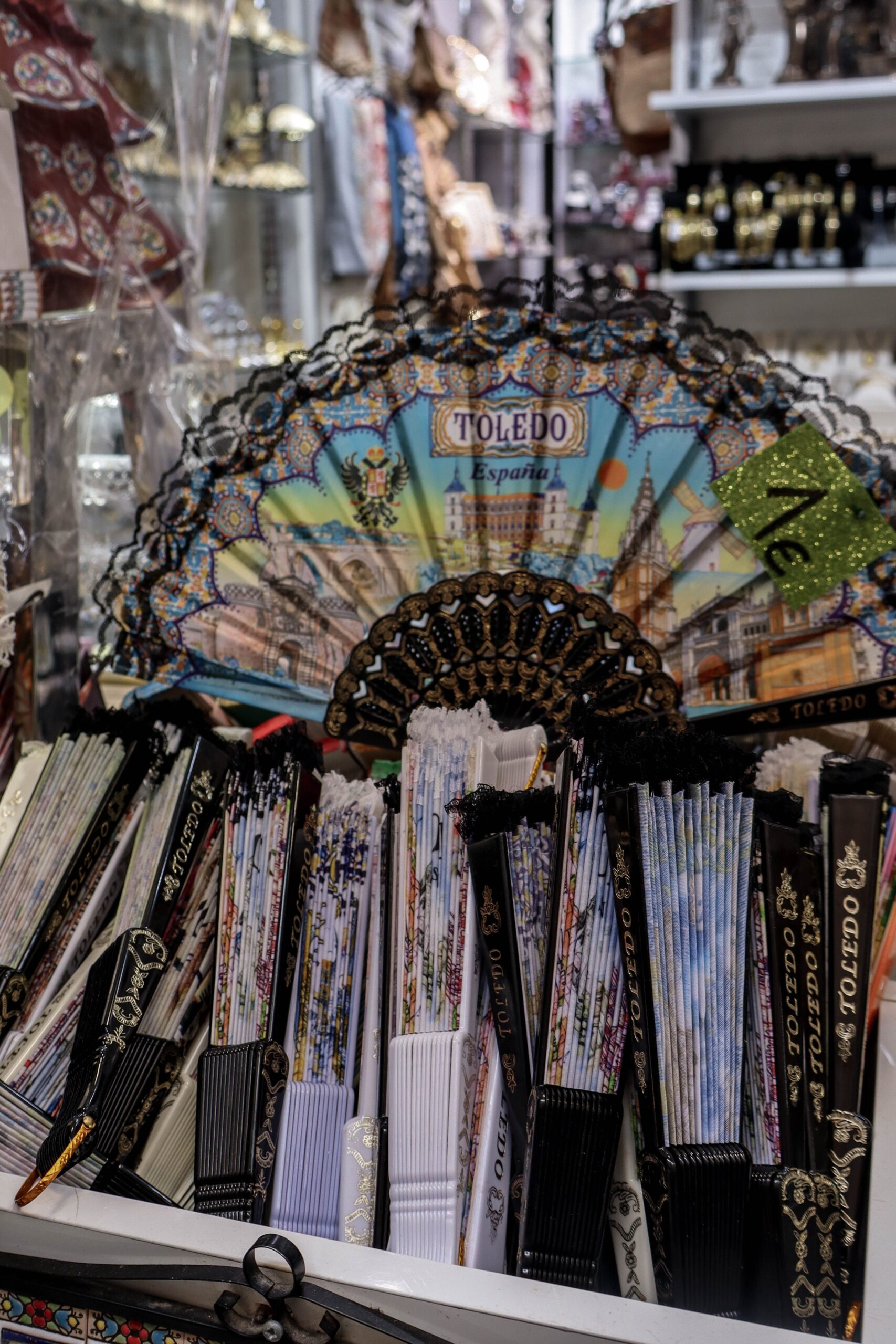
Snap one open on a July afternoon in Seville and you understand the abanico instantly: it is air-conditioning you can fold into a handbag. But the folding fan is not originally Spanish at all — it arrived from Asia by sea, and Spain simply refused to give it back, turning a foreign object into a national reflex. This is Guide № 003 in The Love Spain Guide series.
Get the Full Collectible Guide (Free PDF)
The Fan (Abanico) — in a beautifully designed, printable booklet. The Love Spain Guide № 003.
How the Fan Reached Spain
Rigid, non-folding fans existed across the ancient Mediterranean, but the folding fan — the kind that collapses into a slim baton — came to Europe from East Asia along Portuguese and Spanish trade routes in the sixteenth century. Once it landed, it climbed the social ladder fast, moving from a luxury import for the aristocracy to an everyday object carried by women of nearly every class.
By the eighteenth and nineteenth centuries the fan was fully woven into Spanish daily life, and Spain became one of the great European centres of fan production rather than merely a market for them. What began as an exotic novelty ended up so associated with the country that “Spanish fan” now reads as a category of its own.
Anatomy of an Abanico
A fan has two main parts. The rigid ribs are the varillas, traditionally cut from wood, bone, mother-of-pearl or tortoiseshell, and the two outer ribs — thicker and often the most decorated — are the guards. Stretched across the upper ribs is the país, the pleated leaf made of paper, fabric, silk or lace, which carries the painted or printed decoration. A single rivet at the base, the pivot, holds everything together and lets the whole thing fold flat.
Not every fan folds. A pai-pai is a rigid fan on a fixed handle, while the pericón is an oversized folding fan often used in dance and on stage because its large país reads well from a distance. The finest pieces are still assembled and hand-painted individually, which is why a serious abanico costs far more than the printed souvenirs sold near the cathedrals.
Valencia, the Home of the Spanish Fan
The heart of Spanish fan-making is the region of Valencia, and in particular the town of Aldaia, long a hub of workshops that produce the ribs and assemble finished fans. The trade there is old enough and organised enough that Aldaia is home to a dedicated fan museum, the Museo del Abanico, documenting the craft and its tools.
Making a good fan is a divided craft: some workshops specialise in cutting and shaping the varillas, others in painting the país, others in the final assembly and riveting. That division of labour, passed between family businesses, is part of why the tradition has survived industrial competition. In Madrid, meanwhile, historic specialist shops such as Casa de Diego have sold fans and umbrellas since the early nineteenth century.
More Than Cooling Air
The fan’s first job is genuinely practical. In a country where summer temperatures regularly climb well past 35°C, a fan is a cheap, silent, battery-free way to move air across your face, and you will still see it used constantly — on public transport, at outdoor concerts, in churches and at religious processions during Holy Week.
It also has a performance life. In flamenco and other Spanish dance, the fan becomes a prop that extends the line of the arm and punctuates the music with its snap and sweep, which is one reason the larger pericón is favoured on stage. The sharp crack of a fan opening in one flick is a skill in itself, and doing it cleanly takes practice.
The So-Called Language of the Fan
You will hear that Spanish women once conducted whole courtships in code — fan against the right cheek for “yes,” drawn across the eyes for “I am sorry,” and so on. This lenguaje del abanico is a wonderful story, and it is repeated everywhere, but historians treat it with real caution.
Much of the supposed “fan language” appears to have been popularised, and in places outright invented, by nineteenth-century fan sellers as clever marketing — printed leaflets and pamphlets that helped move stock. That does not mean women never signalled with their fans; a raised or lowered fan can obviously carry meaning. But the idea of a fixed, universally understood dictionary of gestures is best treated as commercial folklore rather than documented history.
Myths Worth Retiring
Myth: The fan is an ancient native Spanish invention. The folding fan reached Europe from East Asia through sea trade in the sixteenth century. Spain adopted it and became a major producer, but the folding design was not born there.
Myth: There is one official secret language of the fan. The famous gesture “code” was largely spread and embellished by nineteenth-century sellers as marketing. Fans could signal mood, but a single authoritative dictionary of moves is folklore, not fact.
Myth: Any pretty fan is a proper Spanish abanico. Most items sold to tourists are printed and machine-assembled. A traditional fan is defined by hand-shaped varillas and a hand-decorated país, and it is priced accordingly.
Frequently Asked Questions
Do Spanish people actually still use fans, or is it just for tourists?
They genuinely use them. In summer you will see fans in daily use across all ages, especially on hot public transport, at outdoor events and during long church services and processions. It remains a practical tool, not only a souvenir.
Where can we buy a good-quality abanico?
Look for specialist fan shops rather than general souvenir stalls. Valencia and Madrid have long-established sellers, and the Valencian town of Aldaia is the traditional manufacturing centre. Check for hand-finished ribs and a hand-painted leaf, and expect to pay more than a printed version costs.
What is the difference between a pericón and a normal fan?
A pericón is simply an unusually large folding fan. Its bigger leaf makes it well suited to dance and stage use, where the movement and the país need to be visible from a distance, whereas an everyday abanico is sized to fit a bag.
More The Love Spain Guides
The Love Spain Guide is a numbered series — one tightly focused subject at a time, each with its own downloadable collectible edition. Guide № 001 is Jamón Ibérico, Guide № 002 is La Tomatina, This is Guide № 003. More editions are on the way.
🇪🇸 Join Love Spain
Every week, get hidden stories, local secrets, and travel inspiration from people who live and love it.
Tours & experiences in Spain


Powered by Viator. Some links are affiliate links — we may earn a small commission at no extra cost to you.