
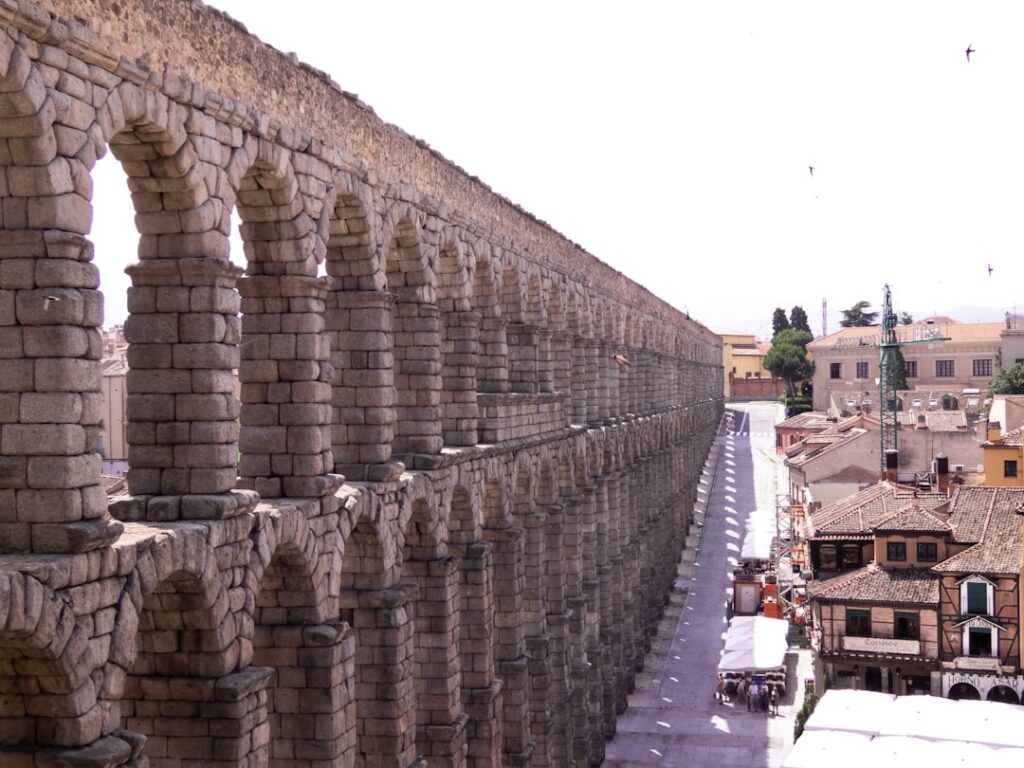
Segovia rises from the Castilian plain like a ship made of stone, its prow dominated by a Disney-worthy castle and its spine supported by a Roman aqueduct that’s been standing for two thousand years. Just an hour northwest of Madrid, this UNESCO World Heritage city packs more architectural drama into a single day than most Spanish cities manage in a week.
Come for the aqueduct, stay for the castle, and don’t leave without tasting cochinillo asado—roast suckling pig so tender that local restaurants ceremonially slice it with the edge of a plate.
Getting There and Getting Around
High-speed trains run from Madrid’s Chamartín station to Segovia-Guiomar in 27 minutes, though the station sits three miles from the old town. Bus 11 shuttles passengers to the aqueduct every 20 minutes. The alternative: regular Renfe trains from Madrid Atocha to central Segovia station take 90 minutes but drop you a 15-minute walk from the aqueduct.
Most visitors walk everywhere once inside the old town. From the aqueduct to the Alcázar is a gentle uphill mile along Calle Real, Segovia’s medieval main street lined with pastry shops and knick-knack stores. The entire historic center is compact and gloriously car-free.
If you’re combining Segovia with other destinations, several tour operators offer day trips that pair the city with nearby Ávila or Toledo. Viator runs multi-city tours that handle transport and give you guided context at major sites.
The Aqueduct: Rome’s Gift to Spain
The Aqueduct of Segovia dominates Plaza del Azoguejo with 167 arches stacked two stories high. Built sometime in the first or second century AD—without mortar—it carried water from the Frío River ten miles away until 1973. Stand underneath and crane your neck: the granite blocks are held together by precise Roman engineering and sheer gravity.
Early morning is magical, when the tour buses haven’t arrived and the low sun turns the stone golden. By 11 a.m., the plaza fills with day-trippers. Climb the steps beside the aqueduct to Calle Cervantes for the best photos looking down the arches toward the mountains.
Free to visit and impossible to miss, the aqueduct anchors the lower town. From here, follow the uphill route toward the cathedral.
Alcázar: The Castle That Inspired Cinderella
Perched on a rocky crag where two rivers meet, the Alcázar de Segovia looks like something out of a storybook—and it is. Disney modeled Cinderella Castle partly on this 12th-century fortress, with its conical turrets and dramatic cliff-edge position.
The interior royal apartments gleam with Mudéjar ceilings and medieval weaponry. The Hall of Kings features a frieze of 52 carved and painted monarchs, their gilded faces watching visitors file past. But the real reward is climbing the 152 narrow steps of the Torre de Juan II. At the top, Segovia sprawls below: terracotta roofs, the cathedral’s honey-colored dome, and the Guadarrama Mountains on the horizon.
The Alcázar is open daily, with tickets around €6 (€9 including the tower). Go early or late—mid-afternoon brings crowds that bottleneck in the narrow staircases.
Where to Eat Cochinillo
Segovia’s signature dish is cochinillo asado, a suckling pig no more than three weeks old, slow-roasted in a wood-fired oven until the skin crackles and the meat falls apart. Restaurants serve it whole on an earthenware platter, often with a theatrical flourish.
Mesón de Cándido, just below the aqueduct, has been roasting pigs since 1786 and remains the most famous address. Expect white tablecloths, formal service, and a bill that reflects its reputation. The cochinillo here is flawless, served with roasted potatoes and a green salad.
Restaurante José María on Calle Cronista Lecea offers equally good pig in a slightly less touristy setting. The portions are enormous—half a pig easily feeds two. Order a bottle of Ribera del Duero and settle in.
For something lighter, try Limón y Menta near Plaza Mayor, where inventive tapas and good wine flow in a modern, casual space. The grilled octopus and Segovian cheeses are excellent.
The Cathedral and Jewish Quarter
Segovia’s cathedral, built in the 16th century after the previous one burned during a revolt, is one of Spain’s last great Gothic churches. Its pale stone and soaring tower dominate the Plaza Mayor. Inside, the carved choir stalls and stained glass warrant a look, but the cloister—transplanted from the earlier cathedral—is the highlight, with delicate columns and a small museum of religious art.
Wander the lanes of the old Jewish quarter east of Plaza Mayor. The narrow streets around Calle Judería Vieja feel medieval and lived-in, with neighborhood bars and small museums like the Centro Didáctico de la Judería, which tells the story of Segovia’s Sephardic community before the 1492 expulsion.
When to Visit
Spring and fall are ideal—warm days, cool nights, and fewer crowds than summer. Segovia sits at 3,300 feet, so even summer evenings are pleasant, though July and August bring tour buses by the dozen.
Winter can be bitterly cold, with the Guadarrama peaks snow-covered. But if you’re in Madrid for the holidays and want an easy escape, a winter day in Segovia—followed by cochinillo by a roaring fire—is hard to beat.
Plan at least five hours for a relaxed visit: an hour at the aqueduct and lower town, two hours to walk to the Alcázar via the cathedral, and two hours for a long lunch. If you’re a museum lover, add time for the Museo de Segovia or one of the Romanesque churches scattered through the old town.
Want more stories like this delivered to your inbox? Subscribe to the Love Spain newsletter—one short story about Spain every day, from hidden villages to essential dishes.
Heads up — some links in this article are affiliate links. If you sign up through them, we may earn a small commission at no extra cost to you. We only recommend tools we use ourselves.
Tours & experiences in Spain


Powered by Viator. Some links are affiliate links — we may earn a small commission at no extra cost to you.