
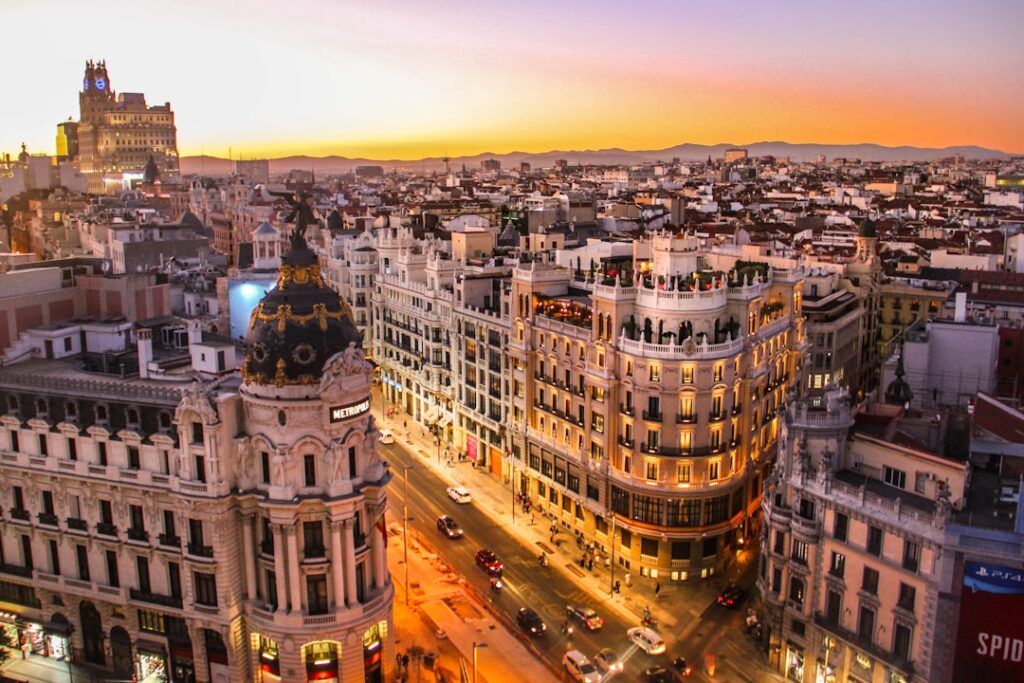
Spain rewards first-time visitors with an embarrassment of riches: world-class art museums, Moorish palaces that feel like dreams, beaches that glow turquoise in the afternoon sun, and food so good you’ll plan your next trip before you’ve left. But where do you start when a country offers this much?
These ten destinations form the backbone of any great first trip to Spain. String together three or four for a focused itinerary, or save the rest for next time—because there will be a next time.
Barcelona and the Sagrada Família
Barcelona tops most Spain itineraries for good reason. Antoni Gaudí’s unfinished basilica, the Sagrada Família, is the city’s calling card—a soaring forest of stone that looks like no other building on earth. Book tickets online weeks ahead; same-day entry is nearly impossible in summer.
But Barcelona is more than Gaudí. Stroll Las Ramblas down to the waterfront, get lost in the Gothic Quarter’s medieval lanes, and take the funicular up to Park Güell for mosaic-covered terraces overlooking the city. Stay in the Eixample district for easy access to everything, or choose El Born for narrow streets packed with wine bars and boutiques.
Madrid and the Prado Museum
Spain’s capital doesn’t have a beach or a famous monument that fits on a postcard, but it has soul. The Prado Museum holds one of the world’s finest collections of European art—Velázquez, Goya, Bosch—and you could spend days here. The nearby Reina Sofía is home to Picasso’s “Guernica,” while the Thyssen-Bornemisza rounds out Madrid’s Golden Triangle of art.
When museum legs set in, head to Retiro Park for a rowboat on the lake, or explore the Malasaña and Chueca neighborhoods for tapas bars where locals actually eat. Madrid comes alive after dark; dinner rarely starts before 10 p.m., and the night is young at midnight.
Seville and the Real Alcázar
Seville embodies everything romantic about Andalusia: orange trees lining cobblestone streets, flamenco echoing from tavern doorways, and the jaw-dropping Real Alcázar, a royal palace where Christian and Moorish design merge into something breathtaking. The adjacent Seville Cathedral is the largest Gothic cathedral in the world; climb the Giralda bell tower for rooftop views across the city.
The Plaza de España, built for the 1929 exhibition, is one of Spain’s most photogenic spots—a massive semicircular plaza with hand-painted tile alcoves representing every Spanish province. Visit early morning or late afternoon to avoid tour groups.
Granada and the Alhambra
The Alhambra is Spain’s most visited monument, and it earns every bit of that attention. This sprawling Moorish palace complex sits above Granada like a red fortress, its interior rooms filled with intricate stucco work, reflecting pools, and gardens where water trickles through marble channels. Tickets sell out months ahead in high season—book the moment your travel dates are firm.
After the Alhambra, wander the Albaicín, Granada’s old Moorish quarter. Its narrow streets wind uphill past white-washed houses and tea shops, leading to the Mirador de San Nicolás, where sunset views of the Alhambra against the Sierra Nevada are unforgettable.
Toledo: The Medieval Hilltop City
Just 30 minutes from Madrid by high-speed train, Toledo feels centuries removed from the capital. This walled city perched above the Tagus River was once home to Christians, Muslims, and Jews living side by side, and that layered history shows in its synagogues, mosques-turned-churches, and Gothic cathedral.
El Greco lived and worked here; his masterpiece “The Burial of the Count of Orgaz” hangs in the Church of Santo Tomé. Toledo makes an easy day trip from Madrid, but stay overnight if you can—the city empties of tour groups by evening, and you’ll have its lamplit streets almost to yourself.
Córdoba and the Mezquita
The Mezquita of Córdoba is one of the most astonishing buildings in Europe: a former mosque filled with a forest of red-and-white striped arches that seems to stretch infinitely in every direction. When Córdoba fell to Christian forces in the 13th century, they built a Renaissance cathedral right in the middle—bizarre, but somehow it works.
The old Jewish Quarter (La Judería) surrounds the Mezquita with whitewashed alleys, flower-filled patios, and tapas bars serving salmorejo, Córdoba’s thicker, richer cousin to gazpacho. May brings the Patios Festival, when residents open their flower-covered courtyards to visitors.
Valencia: Paella’s Birthplace
Valencia gave the world paella, and eating the real thing here—saffron-scented rice cooked over an open flame with chicken, rabbit, and green beans—is a revelation. Head to the beachside neighborhood of El Cabanyal or the Albufera lagoon just south of the city, where restaurants cook paella in giant pans for Sunday lunch.
The futuristic City of Arts and Sciences, designed by Santiago Calatrava, looks like it landed from another planet. The historic center offers another side of Valencia: the Central Market’s Art Nouveau interior, the Gothic Silk Exchange, and the cathedral that claims to hold the Holy Grail.
San Sebastián and Basque Pintxos
San Sebastián turns eating into an art form. The old town is packed with pintxos bars—the Basque version of tapas—where counters overflow with small bites on bread: seared foie gras, spider crab, grilled octopus, wild mushrooms. The local tradition is to bar-hop, having one or two pintxos and a glass of txakoli (Basque white wine) at each stop.
La Concha beach curves along the bay in a perfect crescent, with Belle Époque buildings facing the sand. Take the funicular up Monte Igueldo for panoramic views, or hike to the top of Monte Urgull for harbor perspectives and a bit of history.
Mallorca: Beyond the Beach Resorts
Mallorca gets a bad rap as a package-holiday island, but venture beyond the mega-resorts and you’ll find dramatic mountain villages, hidden coves with crystalline water, and Palma—a sophisticated capital with a stunning Gothic cathedral, tapas bars, and art galleries in converted palaces.
The Serra de Tramuntana mountain range offers some of Europe’s best coastal driving and hiking. The villages of Deià and Valldemossa cling to hillsides planted with olive and citrus groves. Rent a car to explore properly; buses exist but run infrequently outside Palma.
Málaga: The Costa del Sol’s Cultural Heart
Málaga was once just the airport for Costa del Sol beach resorts, but the city has transformed into a cultural destination worth several days. The Picasso Museum occupies a 16th-century palace—fitting, since Picasso was born here—and the Centre Pompidou’s colorful glass cube on the waterfront brings contemporary art to the port.
The Alcazaba, a Moorish fortress above the city, rivals Granada’s Alhambra but sees a fraction of the crowds. Below, the historic center is a tangle of pedestrian streets lined with seafood restaurants serving fried fish by the kilo. August is brutally hot; spring and fall are ideal.
Plan Your Route
Spain’s high-speed AVE trains connect these destinations efficiently. Barcelona to Madrid takes 2.5 hours; Madrid to Seville just 2.5 hours as well. Book trains through Renfe, Spain’s national railway, ideally a few weeks ahead for better prices. Domestic flights are affordable too—check Vueling and Iberia for routes.
First-time visitors often try to do too much. Pick one or two regions to explore properly rather than racing through everything. Spain isn’t going anywhere, and neither is your next visit.
Want more Spain travel inspiration delivered daily? Subscribe to the Love Spain newsletter—one short story about Spain, every day in your inbox.
Tours & experiences in Spain


Powered by Viator. Some links are affiliate links — we may earn a small commission at no extra cost to you.