
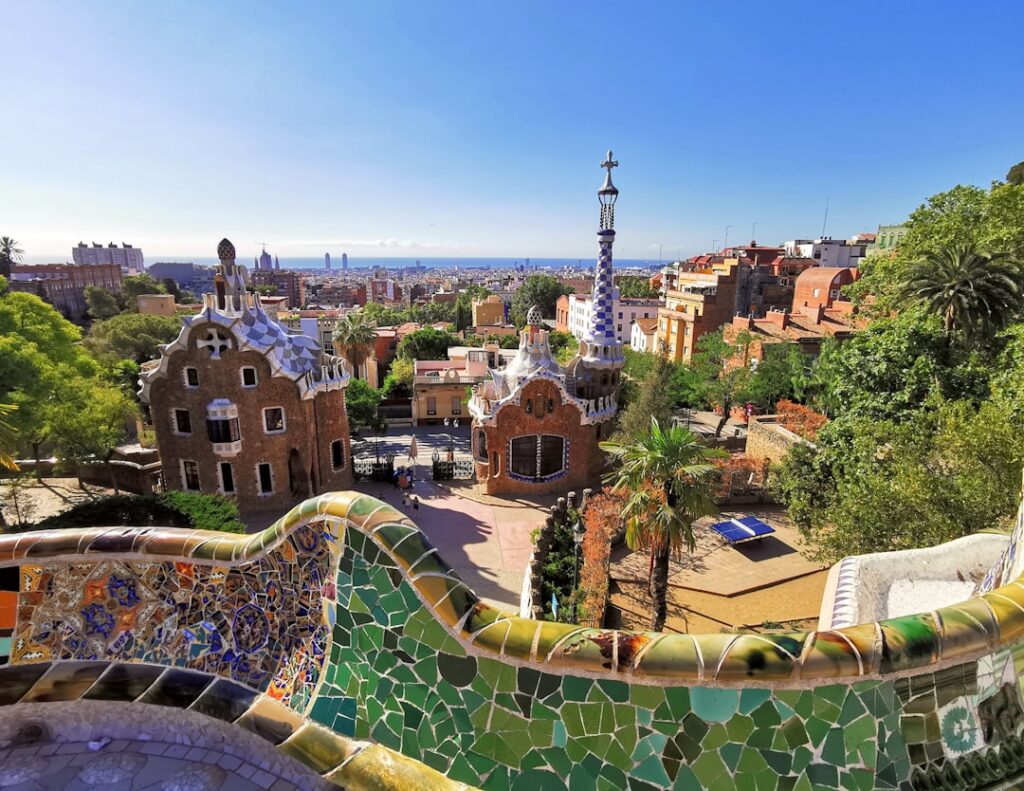
Perched on Carmel Hill in Barcelona’s Gràcia district, Park Güell is Antoni Gaudí’s fever dream come to life—a swirling, colorful mosaic park where nature and architecture blur into something magical. What began in 1900 as a failed luxury housing development became one of Barcelona’s most beloved landmarks, a UNESCO World Heritage Site where every corner reveals another whimsical detail.
If the Sagrada Família shows Gaudí’s spiritual side, Park Güell reveals his playful genius. The park’s undulating forms, broken-tile mosaics, and organic shapes feel less like construction and more like growth, as if the structures sprouted from the hillside itself.
The Monumental Zone: Where the Magic Happens
The heart of Park Güell is the Monumental Zone, the ticketed area where you’ll find the park’s most famous features. Enter through the main gate on Carrer d’Olot, and you’re immediately greeted by two gingerbread-house gatehouses with their mushroom-shaped roofs covered in trencadís—Gaudí’s signature broken-tile mosaic technique.
The grand staircase leads up past the famous mosaic dragon (actually a salamander, but everyone calls it the dragon), one of the most photographed spots in Barcelona. The creature guards a fountain, its scales gleaming in fragments of colored ceramic that catch the Mediterranean light.
At the top of the stairs, you’ll find the Hypostyle Room, a forest of 86 Doric columns that was meant to be the housing development’s marketplace. The ceiling above features more trencadís mosaics, including four circular designs representing the seasons. The columns aren’t just decorative—they’re hollow, designed to channel rainwater into an underground cistern.
Above the columns sits the main terrace, home to the park’s most iconic feature: the serpentine bench. This 110-meter-long undulating seat wraps around the plaza’s edge, covered entirely in a riot of broken tiles, glass, and ceramic. Gaudí’s collaborator Josep Maria Jujol created these mosaics, incorporating everything from factory rejects to broken cups and bottles. The bench’s curves aren’t random—they’re ergonomically designed to fit the human body. Find a spot, settle in, and enjoy sweeping views across Barcelona to the Mediterranean.
Beyond the Monuments: The Free Zones
Most of Park Güell is actually free to enter. The wooded areas above and around the Monumental Zone offer peaceful walking paths, views, and more Gaudí touches without the ticket price or crowds. The Turó de les Tres Creus (Hill of the Three Crosses) at the park’s highest point provides 360-degree views of Barcelona—and on clear days, you can see Montserrat in the distance.
The covered walkways called viaducts wind through the hillside, supported by columns that look like trees or elephant legs, creating shaded paths that stay cool even in summer. These paths connect different levels of the park and showcase Gaudí’s ability to blend architecture with landscape.
Casa Museu Gaudí, located in one of the only two houses actually built in the development, sits in the free zone. Gaudí lived here from 1906 to 1925, and today it’s a museum displaying furniture he designed and personal effects. It requires a separate ticket from the Monumental Zone.
Practical Tips for Your Visit
Book your tickets online in advance—Park Güell caps daily visitors at 1,400 per half-hour time slot, and tickets regularly sell out, especially in summer and on weekends. Entry costs €10 for adults; Barcelona residents get in free. Your ticket is valid for 30 minutes from your entry time, but once inside, you can stay as long as you like.
Early morning visits (8:00 or 8:30 a.m. slots) offer the best light for photos and fewer crowds. Late afternoon slots work well too, especially in summer when you can catch sunset over the city.
Getting there is straightforward: take Metro Line 3 to Lesseps or Vallcarca stations, then walk uphill for 15-20 minutes. The walk from Vallcarca is shorter but steeper. Bus H6 stops right at the park’s main entrance if you’d rather skip the climb. From central Barcelona, figure 30-40 minutes total travel time.
Wear comfortable shoes—the park is on a hill, and you’ll be walking on uneven surfaces. Bring water, especially in summer, though there’s a small café inside. The Monumental Zone has limited shade, so sunscreen and a hat are essential in warm weather.
Give yourself at least 90 minutes to two hours to see both the Monumental Zone and explore the free areas. Photography enthusiasts could easily spend half a day here.
Making the Most of Park Güell
Don’t just beeline for the famous spots. Wander the viaducts, explore the quiet corners, and look closely at the mosaic details—you’ll find faces, letters, and hidden designs embedded in the tiles. The columns in the Hypostyle Room each have subtle differences worth examining.
If you’re visiting multiple Gaudí sites, consider the combined ticket that includes Park Güell and Casa Vicens, or the Gaudí Bundle that adds the Sagrada Família. These packages save money and can be booked through most Barcelona tour providers.
The neighborhood of Gràcia surrounding the park is worth exploring after your visit. This former village maintains a distinct character from the rest of Barcelona, with narrow streets, local plazas, and excellent cafés and restaurants where you won’t find many tourists.
Ready to discover more of Spain’s treasures? Subscribe to the Love Spain newsletter and get one short story about Spanish travel, culture, and adventure delivered to your inbox each day.
Tours & experiences in Spain


Powered by Viator. Some links are affiliate links — we may earn a small commission at no extra cost to you.