
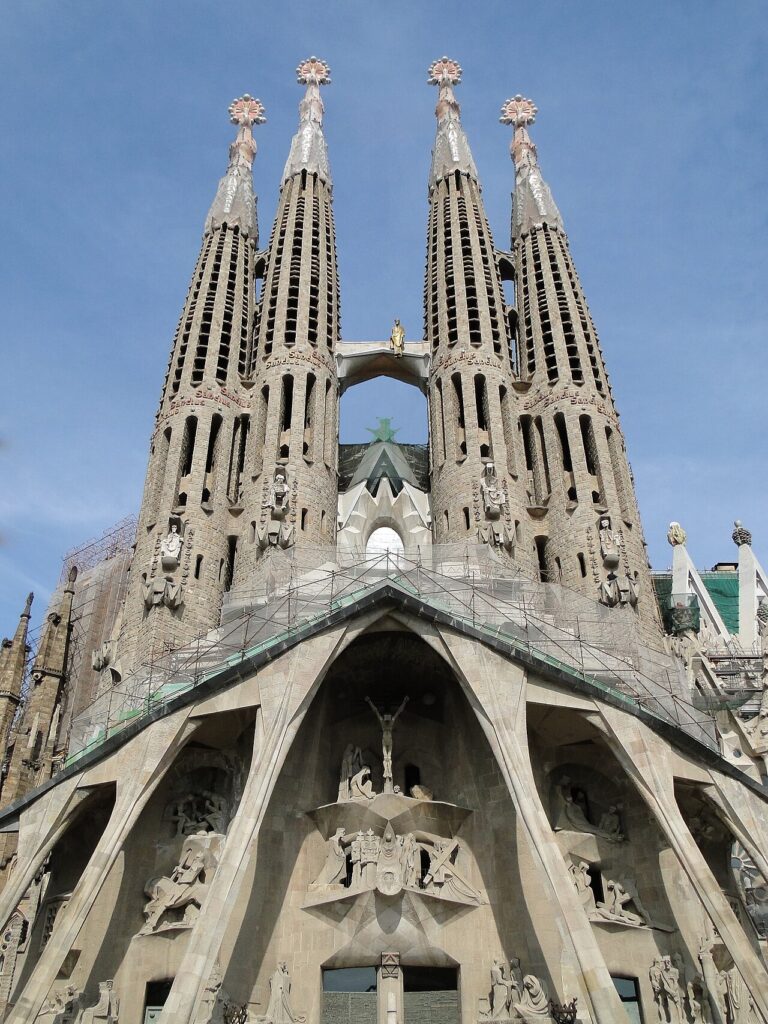
The Sagrada Família isn’t just Barcelona’s most famous landmark — it’s one of the most extraordinary buildings on Earth. Antoni Gaudí’s unfinished basilica has been under construction since 1882, and every year it draws millions who come to stand beneath its soaring columns and stare up at light filtering through stained glass that turns the stone every shade of green, blue, amber, and red.
But visiting well takes planning. Here’s how to do it right.
Book Your Tickets in Advance
This is non-negotiable. The Sagrada Família sells out days or even weeks ahead during peak season, and walk-up tickets are rarely available. Book online as early as you can — ideally when you book your flights.
You’ll choose a specific entry time, and you need to arrive within 15 minutes of it. The basic ticket gets you into the basilica itself, which is the main event. For an extra fee, you can add access to one of the towers — either the Nativity Facade (east side) or the Passion Facade (west side). Both offer spectacular views over Barcelona, but the Nativity tower gives you a closer look at Gaudí’s original sculptural work.
If it’s your first visit, spring for the audio guide. Gaudí’s symbolism runs deep — the columns are designed to mimic a forest, the facades tell biblical stories in stone, and even the floor plan follows sacred geometry. The guide will help you see what you’re looking at.
When to Visit
The Sagrada Família opens at 9:00 a.m., and that first hour is the quietest you’ll get. Morning light through the eastern stained glass windows — blues and greens — is stunning, and the crowds are thinner.
If you’re more interested in golden-hour drama, late afternoon works too. The western windows glow orange and red as the sun sets, and the whole nave seems to catch fire. Book a slot around 5:00 or 6:00 p.m. in summer for this effect.
Avoid midday if you can. That’s when tour groups pack the aisles and it’s hardest to find a quiet moment to just look up.
What to See Inside
Start in the nave. This is where Gaudí’s vision is clearest. The columns branch like trees, and the ceiling vaults create a canopy of stone. He designed it to feel like walking into a forest, and it works. Spend time here. Sit in a pew. Let your eyes adjust to the light.
The Nativity Facade, on the eastern side, was the only part completed during Gaudí’s lifetime. It’s exuberant and organic, covered in vines, animals, angels, and scenes from Christ’s birth. The level of detail is overwhelming — there are turtles at the base of the columns, pelicans above the door, and a cypress tree crowned with doves at the pinnacle.
The Passion Facade, facing west, is stark and angular by comparison. Designed by sculptor Josep Maria Subirachs decades after Gaudí’s death, it shows the crucifixion in sharp, expressionist lines. It’s controversial — some think it clashes with Gaudí’s style — but it’s intentionally severe, meant to convey suffering.
Don’t skip the crypt and museum in the basement. The museum has models, drawings, and photographs showing the basilica’s evolution, plus details about Gaudí’s life and his death in 1926 after being hit by a tram. He’s buried in the crypt below.
The Towers
If you’ve booked tower access, be ready for tight spiral staircases (you go up by elevator, down by foot) and some serious vertigo if you’re not good with heights. The views are worth it: you’ll see the city stretching to the sea, and you’ll be close enough to the spires and mosaics to appreciate details invisible from the ground.
The Nativity tower is generally considered the better choice for first-timers — it’s Gaudí’s original work, and the naturalistic carvings are extraordinary up close.
How to Get There
The Sagrada Família has its own metro stop on the L2 (purple) and L5 (blue) lines. It’s a two-minute walk from the exit to the basilica entrance. If you’re coming from the Gothic Quarter or El Born, it’s about 25 minutes on foot, or you can take the metro from Jaume I or Liceu.
Give yourself at least 90 minutes inside, longer if you’re doing a tower. If you’re short on time, prioritize the nave and the Nativity Facade.
One Last Tip
After your visit, walk around the exterior. Each facade tells a different story, and the building looks completely different depending on where you stand. The southern side, facing the pond in the small park, offers the best photo op — the basilica reflected in the water with palms in the foreground.
And if you want to understand what you’ve just seen on a deeper level, consider coming back for a second visit. The Sagrada Família is one of those rare places that rewards return trips. The light changes, the crowds shift, and you notice things you missed the first time.
Want one short story about Spain in your inbox every day? Subscribe to the Love Spain newsletter — sharp, useful travel intel you’ll actually read.
Tours & experiences in Spain


Powered by Viator. Some links are affiliate links — we may earn a small commission at no extra cost to you.